Key Takeaways
- The traditional boundary between "working" and "learning" is dissolving as the half-life of skills shrinks
- AI makes knowledge accessible in the moment of need, not just in scheduled training
- Organizations must shift from event-based training models to infrastructure for continuous, in-flow development
- The organizations that embrace this merger will develop more capable, adaptable workforces
For decades, work and learning have been separate activities. You learn, then you work. You step away from work to learn more. Training happens in classrooms or LMS modules, distinct from the job itself. The calendar blocks are different. The systems are different. The mindset is different.
That separation is collapsing.
The half-life of skills is shrinking. What you learned five years ago may already be outdated. The pace of change—technological, market, organizational—means continuous learning isn't optional. It's survival.
At the same time, the tools for learning are changing. Knowledge is becoming accessible in the moment of need, not just in scheduled training. AI can answer questions, provide guidance, and support skill development right where work happens. The boundary between "I'm working" and "I'm learning" is blurring.
Organizations that recognize this shift and adapt to it will develop more capable workforces. Those that cling to the old separation will find their people perpetually behind.
The old model made sense once
The traditional separation of work and learning had logic behind it. Knowledge changed slowly. What you learned in school or early career training remained relevant for decades. Periodic updates—a conference here, a course there—were sufficient to stay current.
Learning required dedicated resources. Classrooms, instructors, and printed materials. You couldn't just learn anywhere; you had to go to where learning happened.
The era of scarcity: Information was scarce. Books, experts, and formal education—these were the gateways to knowledge. Learning was something you had to seek out, and someone had to provide. Work was about execution. You learned what you needed, then you applied it. The learning phase and the doing phase were sequential.
None of these conditions holds anymore.
What changed
- Knowledge now has an expiration date. Technology advances, markets shift, and best practices evolve. The person who stops learning doesn't stay in place—they fall behind.
- Learning resources are everywhere. The constraint isn't access to information; it's finding the right information at the right time. The internet, digital content, and AI—knowledge is abundant and available.
- Work itself has become more complex. Routine execution is increasingly automated. What remains for humans is judgment, problem-solving, and adaptation—all of which require continuous learning.
- And AI has created a new interface for knowledge. Instead of searching, reading, and synthesizing, you can ask a question and get an answer. Learning becomes conversational and immediate.
The result: the activities we call "work" and "learning" now happen in the same moments, using the same tools, in service of the same goals.
What merging actually looks like
This isn't abstract. It's already happening in organizations.
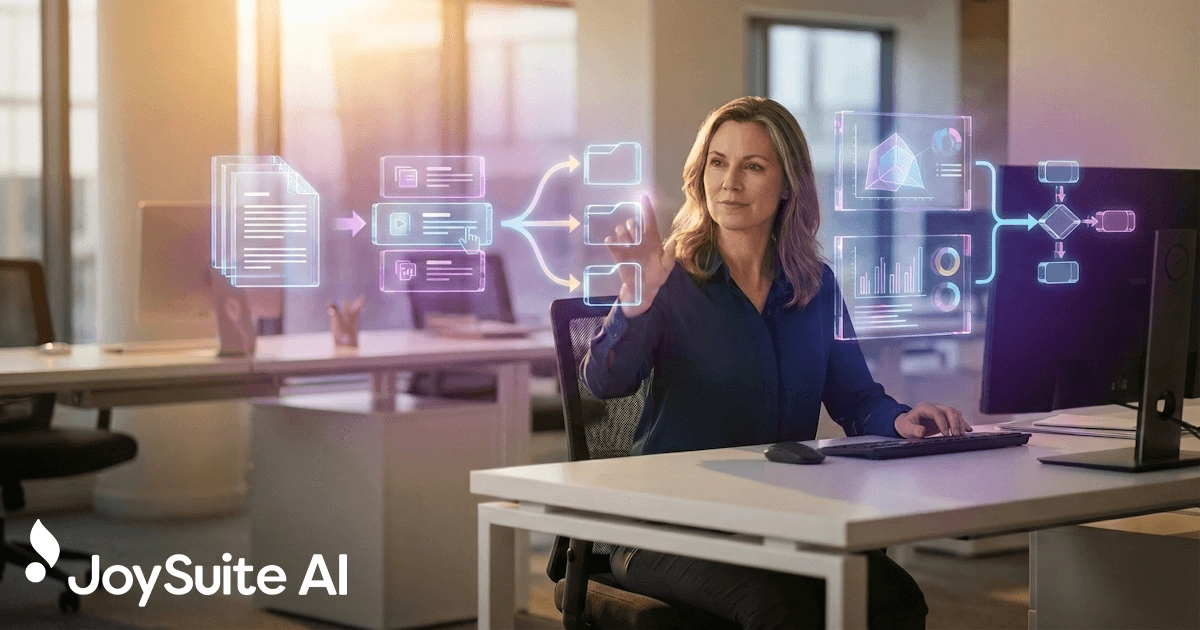
In-flow troubleshooting. An employee encounters a situation they don't know how to handle. Instead of scheduling training or asking a manager, they query an AI assistant and get guidance in seconds—just-in-time learning in action. They learn and apply at the same time.
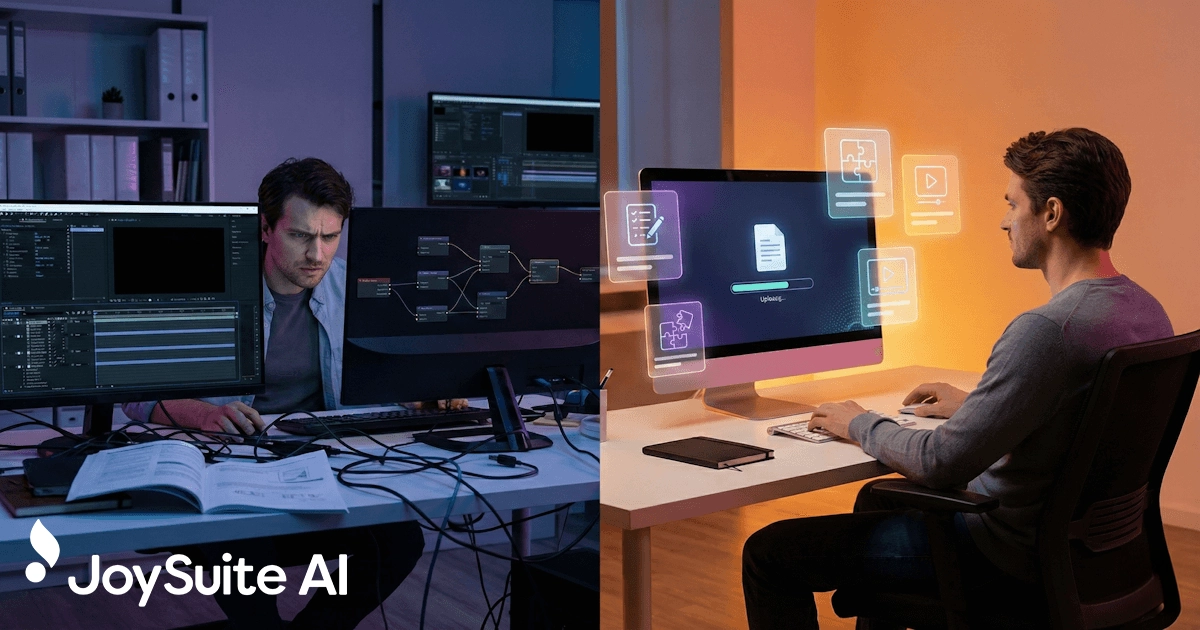
Immediate tool adoption. A team adopts a new tool. Instead of sitting through training before they can use it, they start using it—with AI-powered help available when they get stuck. Learning happens through doing, supported by on-demand guidance.
Real-time process updates. An organization changes a process. Instead of creating training modules and waiting for everyone to complete them, they update the knowledge base. Employees learn the new process when they encounter it, asking questions as they go.
Simulated practice. A professional needs to develop a new skill. Instead of waiting for a course, they practice through AI-simulated scenarios, getting feedback and improving in real-time.
In each case, learning isn't a separate activity. It's embedded in the work itself.
Why this matters for organizations
If work and learning are merging, organizations built around their separation face structural problems.
L&D is organized around events and courses. If most learning happens in the flow of work, what's the role of a team organized around building and delivering formal training? The work doesn't disappear, but it fundamentally changes. This is the death of click-next training as we know it.
- Systems that don't talk to each other create friction. The LMS over here, the knowledge base over there, the work tools somewhere else. If learning happens during work, the systems need to be integrated, not siloed.
- Metrics that count completions become irrelevant. Tracking who finished which module made sense when training was the learning. If learning happens everywhere, completion rates measure a shrinking fraction of actual development.
The evolution of management
Managers are often unprepared for a coaching role. If employees are learning constantly through their work, managers become development partners, not just taskmasters. That requires different skills and different time allocation. Career development is no longer a sequence of milestones where you learn a skill, get certified, and advance. Continuous learning is harder to measure and credential, requiring a shift in how we recognize growth.
What leaders need to do
Recognizing the shift is the first step. Adapting to it requires deliberate action.
- Make knowledge accessible where work happens. Information employees need should be available in the tools they're already using, in the moments they need it. Not in a separate system they have to remember to check.
- Invest in AI that supports learning in context. Use AI assistants that can answer questions, provide guidance, and support skill practice—integrated into work, not relegated to a training platform. This is where much of the learning infrastructure is heading.
- Rethink the L&D function. Shift from content creation and delivery to knowledge curation and learning culture. From training events to learning infrastructure. The skills needed are changing; the mission is evolving.
- Help managers become coaches. If employees are learning continuously, managers need to support that learning—through feedback, through guidance, through creating space for development. This needs to be part of the manager's job description, not an afterthought.
- Measure what matters. Completion rates won't capture embedded learning. Look instead at capability growth, performance improvement, adaptability, and engagement. Harder to measure, but more meaningful.
- Create a culture that expects continuous learning. Not as a burden, but as a feature of how work happens. Curiosity rewarded. Questions encouraged. Development woven into daily expectations. Organizations that build a learning culture, not just training will thrive.
The opportunity
Organizations that embrace this merger gain significant advantages.
learning means the gap between "we need to know this" and "we know this" shrinks dramatically—driving faster adaptation.
- Faster adaptation. When learning happens in real-time, the gap between "we need to know this" and "we know this" shrinks dramatically.
- Better application. Learning in context means learning that's immediately relevant and immediately used. The transfer problem—training that doesn't change behavior—diminishes when learning and doing happen together. Understanding what actually makes learning effective shows why this matters.
- More engaged employees. People who are constantly learning feel more invested in their work. The job isn't just execution; it's growth.
- Competitive agility. The organization that learns faster can change faster. When markets shift or technology changes, the learning organization adapts while others are still scheduling training.
The risk of standing still
The merger of work and learning is happening whether organizations embrace it or not. Employees are already using AI tools to learn on the job—sometimes with organizational support, sometimes on their own.
The question isn't whether this shift happens, but whether organizations shape it intentionally. Those that do will build a learning infrastructure that supports their goals, using tools they've vetted, with content they've curated, in ways that reinforce their culture.
Those that don't will have employees learning from random sources of varying quality, using tools that may not protect their data, and developing in directions that may or may not serve organizational needs. The gap between these outcomes will widen as AI capabilities grow. The time to adapt is now.
Work and learning were never really separate. People have always learned on the job, adapted to new situations, and figured things out as they went. What's changing is the infrastructure that supports this.
The organizations that build that infrastructure—that make knowledge accessible, that enable learning in context, that embrace continuous development—will thrive. The old model served its time. The new one is already here.
JoySuite brings learning to where work happens. Knowledge accessible on demand. AI that supports development. Workflow assistants that embed learning into daily tasks. Training that reinforces, not replaces, learning in the flow of work. The infrastructure for how learning actually happens now.