Key Takeaways
- Use AI hallucinations intentionally for creative tasks like brainstorming and draft generation, while grounding factual queries in verified organizational content to eliminate them.
- Use AI creativity for drafts, variations, and exploration—then verify with authoritative sources
- Grounding AI in your organization's content eliminates hallucinations for factual queries
Let's talk about the elephant in the room when it comes to AI in business: AI hallucinations. It's a term that sounds dramatic, maybe even a little scary, and it's one of the biggest sources of anxiety I hear about when talking to leaders about adopting generative AI tools.
You've probably heard the stories or maybe even experienced it—asking an AI a question and getting an answer that sounds plausible but is completely wrong, misleading, or just… made up. It's understandable why this causes hesitation.
It's a valid source of anxiety for leaders considering integrating generative AI into their operations. How can you entrust critical business tasks to a technology that can seemingly invent information? This feeling of uncertainty can feel like a significant barrier to unlocking the true potential of these powerful new capabilities.
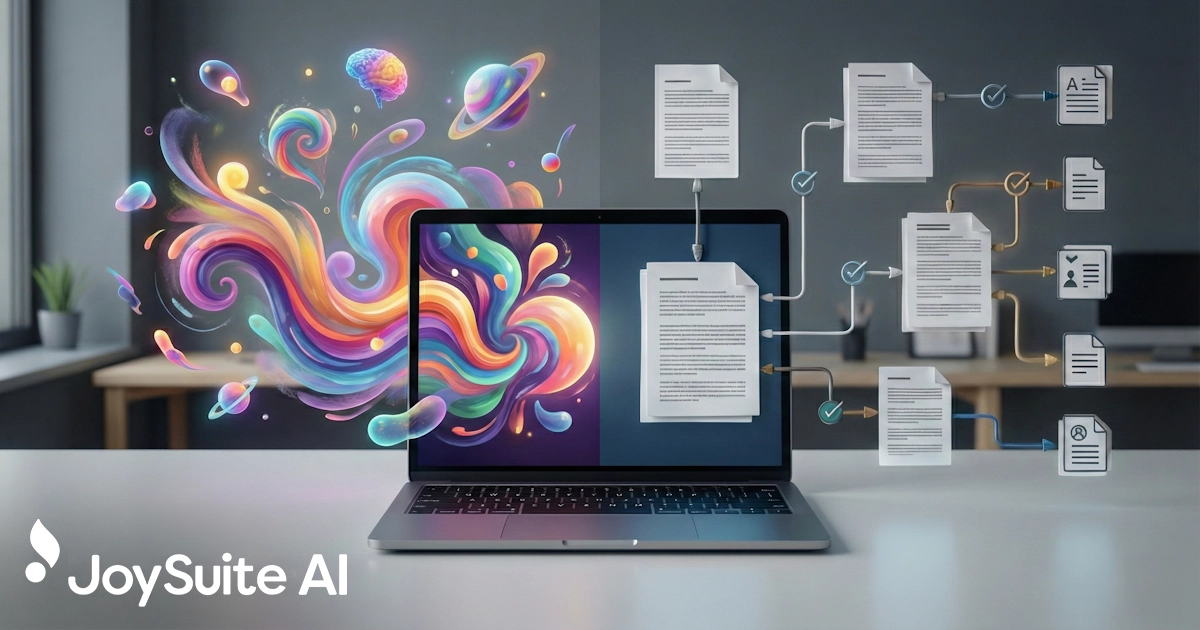
But what if I told you that AI "hallucinations" can have a use for businesses? In this article, we'll explore the ways you can leverage AI hallucinations for creative purposes while still being diligent to ensure you're getting accurate information when you need it.
Understanding the "Creative" Side of AI
Think about how these Large Language Models (LLMs)—the engines behind tools like ChatGPT, Gemini, Claude, and the AI within JoySuite—actually work. They are trained on vast amounts of text and data, learning patterns, relationships, and structures in language. When you ask them a question or give them a prompt, they generate a response by predicting the most likely sequence of words based on that training.
Sometimes, to create a coherent or novel response, especially when asked something open-ended or requiring synthesis, the AI needs to generate connections or ideas that weren't explicitly present in its training data. This is where the "making things up" part comes in.
If AI could only regurgitate facts it was trained on, it wouldn't be useful for creative tasks. You wouldn't ask a fact-checker to write your ad campaign—you want someone who can imagine and invent.
So, the ability to generate novel information isn't inherently bad. The problem arises when this isn't controlled—when the AI generates seemingly factual information that isn't accurate, especially when you need reliable, factual answers based on specific data. Understanding what grounded AI means helps clarify when you can trust AI outputs.
The Solution: AI Knowledge Management with Citations
At Neovation, as we were designing JoySuite's capabilities, we recognized this challenge early on. We knew that for businesses to adopt AI confidently—especially for critical knowledge work—there needed to be a mechanism for trust and verification. That's why we built JoySuite as an AI knowledge management platform with two core principles to manage AI creativity and ensure AI accuracy:
1. Grounding in Your Knowledge
First and foremost, JoySuite's Knowledge Assistant is designed to be grounded in your organization's verified information stored within the JoySuite Knowledge Centre. When you ask a question, JoySuite's primary directive is to find the answer within your specific documents, policies, procedures, and other assets. This immediately narrows the field and significantly reduces the likelihood of the AI inventing answers unrelated to your business context. It forces the AI to prioritize your reality. This is the foundation of effective AI knowledge management.
2. AI That Cites Sources: Transparency Through Citations
This is where we directly tackle the trust issue. JoySuite is AI that cites sources—whenever it provides a piece of factual information from your Knowledge Center content, it includes a citation as to where it pulled the information. This isn't just a vague reference; it's typically a direct link or clear indicator pointing to the specific document, page, or even section where that information was found.
An employee asks: "What is our company policy on parental leave?" JoySuite provides the key details and includes a citation linking directly to the official HR Policy document.
This simple mechanism is incredibly powerful. It provides complete transparency. The user doesn't have to blindly trust the AI's answer. They can instantly click the citation and verify the information against the original, authoritative source document. It turns the AI from a potential black box into a helpful, transparent guide to your company's knowledge.
Distinguishing Reliable Information from Creative Output
This citation-based approach naturally helps users differentiate between information rooted in verified sources and more generative AI output:
When accuracy is key: For questions requiring precise, verifiable answers, citations ensure reliability. If an answer comes with a citation, users know its origin and can verify.
When exploring ideas (no direct citation): When users prompt JoySuite for brainstorming, drafting initial content, or exploring possibilities ("Suggest three taglines for our new product..."), the need for direct citations diminishes. In these scenarios, the output is understood as a starting point for creative exploration, not a definitive piece of internal knowledge.
Information provided without a direct citation in JoySuite generally indicates that it's either drawing from the LLM's general knowledge (common facts not specific to your company) or engaging in a more open-ended generative mode. This distinction, clearly indicated by the presence or absence of citations, empowers users to interpret the AI's output appropriately.
The Benefits of a Trustworthy AI Approach
Implementing a grounded, citation-based strategy yields significant advantages:
- Builds user trust: Transparency fosters confidence. When users can see the source of information, they are more likely to trust the AI as a reliable tool, leading to faster adoption.
- Ensures accuracy: By prioritizing and referencing verified internal documents, you maintain the integrity of information shared within your organization, minimizing the risk of acting on incorrect AI-generated content.
- Saves time: Verification becomes immediate. Users no longer need to search through multiple documents or consult colleagues to confirm information; the source is readily available.
- Reduces risk: Mitigates the potential for errors and misinformed decisions based on fabricated AI responses for critical tasks.
- Empowers users: Provides users with control by making the AI's process transparent and verifiable.
- Improves AI knowledge management: The citation process can highlight frequently accessed documents (indicating their importance) and potentially reveal gaps or inconsistencies in the knowledge base through user feedback.
For organizations evaluating their options, understanding the best AI knowledge management tools available can help identify platforms that prioritize these trust-building features.
Takeaways for Confident AI Adoption
So, how can you move forward with AI confidently, knowing you can manage the risk of AI hallucinations?
Demand transparency: Look for AI platforms that provide clear citations linking factual answers to source documents. This is non-negotiable for building trust.
Remember to reframe AI "hallucinations" as a feature that needs context and control, prioritize grounding in your verified knowledge base, and recognize when you need factual recall versus creative generation. Organizations can also build custom virtual experts trained on specific domains to ensure reliable, grounded responses for critical use cases.
The fear surrounding AI hallucinations is valid if left unmanaged. But with the right approach—grounding the AI in your knowledge and providing transparent citations for verification—you can transform generative AI from a source of anxiety into a trustworthy, powerful engine for productivity and knowledge sharing. This is why capturing institutional knowledge in accessible systems is so valuable.
JoySuite was built as a ChatGPT alternative for business with trust through transparency at its core. Our AI knowledge management platform provides AI that cites sources for every answer, so your team can verify information instantly and use enterprise AI with confidence.