Key Takeaways
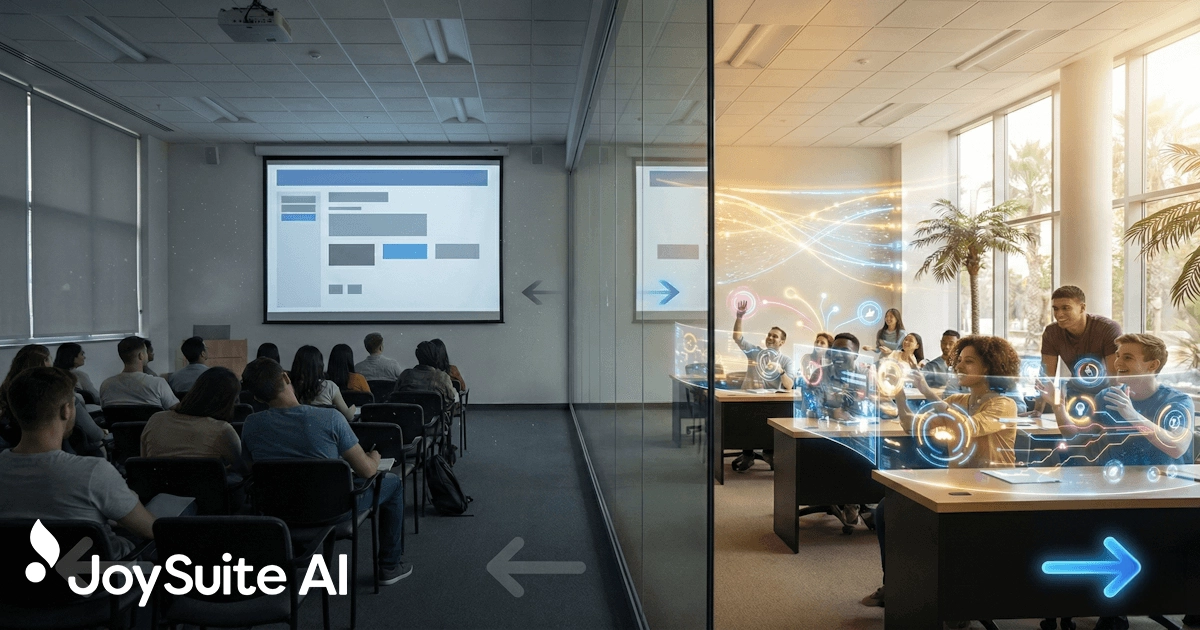
- Traditional LMS platforms focus on content delivery and tracking; AI platforms focus on content creation and knowledge access
- The biggest difference isn't features—it's capacity. AI platforms can produce training at 10x the speed of traditional approaches
- Traditional LMS measures completion; AI platforms can measure actual knowledge retention and mastery
- Organizations don't have to choose one or the other—many use AI platforms alongside existing LMS for different purposes
The term "AI-powered LMS" has become nearly meaningless through overuse. Every learning platform now claims AI capabilities, from genuine content creation engines to basic recommendation systems rebranded with AI buzzwords.
Cutting through this confusion requires understanding what fundamentally changes when AI moves from feature to foundation. The distinction isn't subtle—it's the difference between doing the same things slightly better and doing entirely new things that weren't previously possible.
For a comprehensive overview of AI learning platforms, see AI Learning Platform: The Next Generation of Corporate Training.
How Does a Traditional LMS Work?
Learning management systems emerged in the late 1990s to solve a specific problem: delivering and tracking computer-based training at scale. The model that developed has remained remarkably consistent for over two decades.
How Is Content Created in a Traditional LMS?
In the traditional model, specialized instructional designers create courses using authoring tools like Articulate Storyline, Adobe Captivate, or similar software. This process involves:
- Needs analysis and learning objective definition
- Storyboarding and script development
- Visual design and interaction development
- Review cycles with subject matter experts
- Publishing and uploading to the LMS
Industry benchmarks suggest 40-200 hours of development time per finished hour of eLearning, depending on complexity. A 30-minute compliance module might take a skilled designer 2-6 weeks to complete. This is why many organizations are now exploring AI-powered training content creation to dramatically reduce these timelines.
How Does a Traditional LMS Deliver Training?
The LMS serves as a content library and assignment engine. Administrators upload courses, assign them to employees or groups, and set deadlines and requirements. Learners log in, navigate to their assigned training, complete it, and move on.
How Does a Traditional LMS Track Learning?
Traditional LMS platforms track completion: who took the training, when, and whether they passed the embedded quiz. This data feeds compliance reports and training dashboards. The implicit assumption is that completion equals learning.
The traditional LMS model creates a dangerous equation: completion = learning. But research consistently shows that most training content is forgotten within weeks. Completion tracking masks this reality.
How Does an AI Learning Platform Work?
AI learning platforms operate on different assumptions. Rather than treating content creation as an external process and focusing on delivery and tracking, AI platforms make content creation central and redefine what tracking means.
How Do AI Platforms Create Training Content?
AI platforms can transform existing organizational knowledge into training. Upload a policy document, product guide, or process manual—and generate quizzes, flashcards, scenarios, and coaching sessions in minutes rather than weeks.
This doesn't eliminate the need for human review. But it fundamentally changes the bottleneck. Instead of building from scratch, humans curate and refine AI-generated content. The limiting factor becomes how much knowledge exists in documents, not how many instructional designers you can hire.
How Do AI Platforms Deliver Personalized Learning?
AI platforms adapt delivery to individual learners. Rather than everyone receiving the same static course:
- Pre-assessment identifies what learners already know
- Content that's already mastered can be skipped
- Additional practice focuses on weak areas
- Difficulty adjusts based on demonstrated performance
- Spaced repetition reinforces retention over time
How Do AI Platforms Assess and Track Knowledge?
AI platforms can move beyond completion tracking to mastery verification. Rather than asking "did they finish?" the question becomes "do they know it?"
This happens through:
- Generated assessments with unlimited question variations
- Scenario-based evaluation through AI roleplay
- Ongoing knowledge checks rather than one-time tests
- Retention tracking over time, not just immediately after training
What Are the Key Differences Between a Traditional LMS and an AI Platform?
| Dimension | Traditional LMS | AI Learning Platform |
|---|---|---|
| Content creation time | Weeks to months | Minutes to hours |
| Who creates content | L&D specialists with authoring skills | Anyone with subject matter knowledge |
| Content updates | Rebuild courses manually | Regenerate from updated source documents |
| Personalization | Same course for everyone | Adaptive based on demonstrated knowledge |
| Assessment | Static quizzes, easy to game | Generated questions, roleplay, mastery verification |
| Primary metric | Completion rate | Knowledge retention |
| Scaling approach | More content = more headcount | AI amplifies existing capacity |
| Learner experience | Sequential course navigation | Adaptive paths, conversation, Q&A |
Why Is Content Creation the Biggest Difference Between LMS and AI Platforms?
The most important difference between traditional and AI learning platforms is content creation capacity.
Why Do Traditional LMS Teams Face Content Backlogs?
L&D teams report training backlogs of 50, 100, even 200 pending requests. Every department wants training yesterday, but there's finite design capacity. The result is constant prioritization, frustrated stakeholders, and important training that never gets built.
When content finally gets created, it starts aging immediately. Processes change, policies update, products evolve—but updating courses requires the same laborious process that created them. Maintenance compounds the backlog problem.
How Does AI Solve the Content Creation Bottleneck?
AI platforms attack this bottleneck directly. If training can be generated from documents in minutes:
- The backlog clears faster—requests become fulfillable
- Updates happen easily—regenerate from current documents
- Coverage expands—training on topics that "weren't worth" manual development becomes possible
- Self-service emerges—managers and SMEs can create training without L&D involvement
reduction in content development time is commonly reported when moving from traditional authoring to AI-assisted creation. This doesn't just save time—it changes what training is feasible to produce.
This shift matters because most organizations have far more documented knowledge than they've converted to training. Policies, procedures, product guides, process documents—the raw material exists. What's been missing is capacity to transform it. AI provides that capacity.
How Does AI Personalization Compare to Traditional LMS Delivery?
Traditional LMS platforms offer basic personalization through role-based course assignments. A salesperson gets sales training; an engineer gets technical training. But within each course, everyone gets the same experience.
AI platforms make personalization continuous and adaptive:
How Do Pre-Assessments Personalize AI Learning?
Before diving into content, assess what the learner already knows. An experienced employee might demonstrate mastery of 70% of the material upfront. Why force them through content they've already learned?
What Is Adaptive Learning Pathing in AI Platforms?
As learners progress, AI adjusts the path. Concepts that are clearly understood can be condensed. Areas of struggle get additional explanation, examples, and practice. The result respects learners' time while ensuring everyone reaches competency.
How Does AI Continuously Adjust to Each Learner?
Unlike static courses that are the same on every viewing, AI platforms can present different content, questions, and challenges each time based on the learner's evolving knowledge state.
True adaptive learning requires content depth—alternative explanations, varied examples, multiple difficulty levels. Ask vendors to demonstrate how their adaptation actually works, not just that they claim it.
Does an AI Platform Measure Learning Better Than a Traditional LMS?
Traditional eLearning assessment has a fundamental problem: it's easy to game. Employees learn to click through content just fast enough, take the quiz until they pass, and promptly forget everything. The "click-next" training model produces completions, not competency.
What Are the Limitations of Traditional LMS Assessments?
- Static question pools that learners memorize
- Multiple-choice formats that test recognition, not application
- One-time measurement immediately after training
- No verification of knowledge retention over time
What Assessment Capabilities Do AI Platforms Offer?
- Generated questions: AI can create unlimited question variations from source material, making answer-key memorization impossible
- Scenario-based evaluation: Roleplay with AI to demonstrate skills in realistic situations
- Spaced practice: Regular knowledge checks over time to verify retention
- Application focus: Scenarios and conversations that test whether learners can apply knowledge, not just recall it
The goal shifts from proving someone sat through training to proving they actually learned what the training taught. For more on this shift, see how to measure training effectiveness beyond completion rates.
How Do AI Platforms Provide Knowledge Access Beyond Courses?
Traditional LMS platforms are course-centric. Want to learn something? Find a course, complete it, check the box. But this doesn't match how people actually work.
When an employee faces a challenge at 2 PM on a Tuesday, they don't have time for a 45-minute course. They need an answer now. Traditional LMS platforms can't help with this—they're designed for scheduled learning, not performance support.
AI learning platforms can bridge this gap by providing instant access to organizational knowledge:
- Ask a question, get an answer—sourced from your documents
- Get help mid-task without leaving the work context
- Access just the relevant information, not an entire course
- Receive cited responses so you can verify accuracy
This represents a different model of learning: not just courses you complete, but knowledge you access when needed.
When Should You Use a Traditional LMS vs an AI Learning Platform?
The right choice depends on your specific situation.
Traditional LMS Strengths
- Compliance training: When legal or regulatory requirements demand specific content and documented completion, traditional LMS tracking excels
- Existing content libraries: If you've invested heavily in professionally developed courses, a traditional LMS delivers and tracks them effectively
- Enterprise complexity: Large organizations with complex hierarchies, multiple business units, and intricate compliance requirements may need the administrative sophistication traditional platforms offer (see our AI corporate training platform guide for enterprise-specific concerns)
- Certified programs: When training leads to recognized certifications with specific requirements, traditional structured paths make sense
AI Platform Strengths
- Training backlog: If you can't create training fast enough to meet demand, AI content creation changes the equation
- Rapidly changing content: When policies, products, and processes update frequently, AI's regeneration capability beats manual maintenance
- Documented knowledge: If expertise exists in documents but hasn't been converted to training, AI unlocks this knowledge
- Performance support: When employees need instant answers, not just scheduled courses, AI knowledge access fills the gap
- Scaling without headcount: If you need more training capacity without proportionally more designers, AI provides leverage
The Hybrid Reality
Many organizations don't choose one approach exclusively. They use traditional LMS platforms for:
- Structured compliance programs
- Formal certification tracks
- Third-party content delivery
And AI platforms for:
- Rapid training development
- Knowledge access and Q&A
- Onboarding and product training
- Performance support
The question isn't always "which LMS should we replace with AI?" Sometimes it's "what can AI do that our current LMS can't?" Adding AI capability doesn't require abandoning existing investments.
Making the Transition
If you're considering moving from traditional LMS to an AI platform—or adding AI capability alongside existing systems—consider these steps:
- Identify your bottleneck. Is it content creation, learner engagement, knowledge access, compliance tracking, or something else? AI solves some problems better than others.
- Inventory your content. What documented knowledge exists that hasn't been converted to training? This is the raw material AI platforms can transform.
- Evaluate specific use cases. Don't evaluate platforms abstractly. Test with your actual documents, your real compliance requirements, your specific challenges.
- Plan the transition. Will AI replace your LMS, supplement it, or focus on specific use cases? Different answers require different implementation approaches.
- Prepare your team. AI changes L&D roles from content creation to content curation and quality assurance. Invest in skills development for this transition.
The Convergence Ahead
The distinction between traditional and AI learning platforms will blur over time. Traditional vendors are investing in AI capabilities. AI platforms are adding enterprise features. Eventually, AI will simply be expected in any learning platform.
But the organizations that embrace AI learning now—rather than waiting for features to trickle into their current platforms—gain years of competitive advantage in developing their workforce.
The question isn't whether to adopt AI in learning. It's how quickly, how comprehensively, and whether you'll lead or follow.
For detailed comparison of specific platforms, see Best AI-Powered LMS Software in 2025.
JoySuite was built from the ground up as an AI learning platform—not a traditional LMS with AI added later. Transform any document into training in minutes, not months. Enable instant knowledge access so employees get answers exactly when they need them. And with unlimited users included, deploy to your entire organization without the per-seat constraints that limit traditional platforms.