Key Takeaways
- AI simulation excels at repetition, availability, and consistency—the volume of practice that builds automatic responses.
- Live training excels at nuance, relationship building, and complex judgment—the human elements that simulation can't fully replicate.
- Research shows that simulation is particularly effective for building basic competency, while live training remains important for advanced skill development.
- The optimal approach isn't choosing one over the other—it's using AI simulation for volume and live training for nuance.
- Organizations that integrate both approaches develop sales skills faster and more consistently than those using either alone.
The debate over AI simulation versus live training often gets framed as an either/or question. Should we replace traditional roleplay with AI? Is simulation good enough to replace human coaches?
This framing misses the point. Each approach has distinct strengths and limitations. The question isn't which is better—it's how to use each for what it does well.
Understanding these differences helps L&D leaders, sales managers, and enablement teams build training programs that actually develop skills rather than just checking boxes.
What Does Live Sales Training Do Better Than AI?
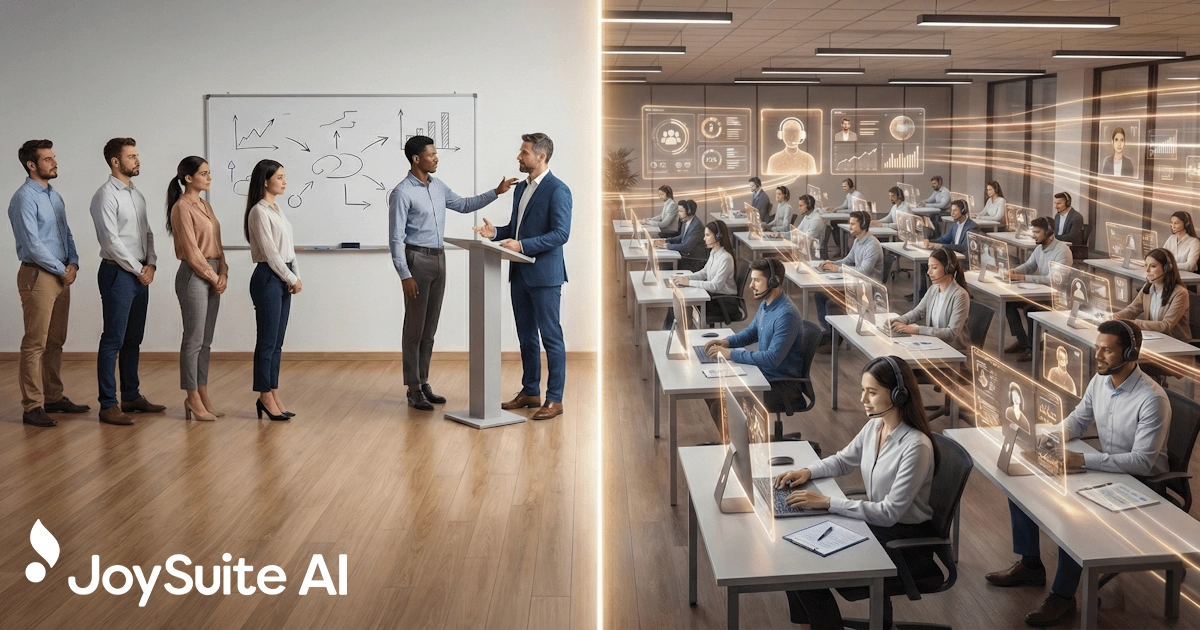
Live training excels at delivering human judgment, nuanced feedback, relationship building, and real-time adaptation to complex scenarios that AI simulation cannot fully replicate.
Traditional live training—workshops, manager-led roleplay, coaching sessions—has been the default for decades. It persists because it genuinely does certain things well.
Human Judgment and Nuance
Experienced trainers and managers bring judgment that AI can't fully replicate. They understand:
- When breaking from the framework was actually the right call
- What the rep's body language conveyed beyond their words
- How the organizational context affects what approach would work
- When a rep is developing a bad habit versus trying something legitimately new
This nuanced evaluation becomes more important as skills become more advanced. For foundational skills, AI feedback is often sufficient. For advanced selling, human judgment matters more.
Relationship Building
Good managers don't just train—they build relationships. Reps who feel their manager cares about their development try harder, persist longer, and stay with the organization more.
AI provides feedback. Humans provide encouragement, recognition, and the sense that someone is invested in your success. These emotional elements affect motivation, which affects learning.
Training isn't just about information transfer. It's about building belief that improvement is possible and worth pursuing.
Complex Scenario Handling
Real sales situations have infinite variations. Live training can adapt in the moment:
- "Actually, let's try that again, but this time the prospect is also dealing with a merger."
- "What if I push back harder? What would you do then?"
- "Good—but what if they said this instead?"
This real-time adaptation creates complexity that mirrors real selling. AI scenarios are getting better, but they're still designed in advance rather than adapted in the moment.
Context and Adaptation
Trainers who know the organization can connect training to specific contexts:
- "Remember how this objection came up in the Acme deal? Here's how I would have handled it."
- "This approach works well with our typical buyer, but adjust it when you're talking to technical buyers."
- "Given our new pricing, you'll see more budget objections. Let's focus there."
This contextual relevance makes training feel applicable rather than abstract.
What Are the Advantages of AI Sales Simulation?
AI simulation provides unlimited repetitions, on-demand availability, consistent feedback quality, and judgment-free practice—addressing the volume and accessibility gaps inherent in live training.
AI simulation addresses specific limitations of live training. Its strengths are complementary, not competitive.
Unlimited Repetitions
Building automatic responses requires repetition—far more than live training typically provides. Research on skill development shows that fluency comes from encountering the same situation dozens of times under varied conditions.
No manager has time to run the same roleplay fifty times with one rep. AI does. This volume of practice transforms declarative knowledge ("I know how to handle this objection") into procedural knowledge ("My response is automatic").
Studies suggest that building automatic skill responses requires 6-12 repetitions under varied conditions—but most training provides only 2-3 repetitions at most.
Consistent Availability
Learning is most effective when it happens in context. The best time to practice is:
- Right before a challenging call
- Immediately after a difficult conversation
- When motivation to improve is high
Live training requires scheduling. AI is available when the learner is ready, which is when learning happens best.
Consistent Quality
Not all managers are equally skilled at training. Some provide excellent feedback; others go through the motions. This variation means some reps develop faster than others based on factors unrelated to their own effort.
AI provides consistent feedback quality across all reps. This consistency creates more equitable development opportunities.
Judgment-Free Practice
Many professionals hold back when practicing with colleagues. There's performance anxiety, fear of looking incompetent, and awkwardness of pretending with someone you know.
AI practice removes social pressure. Reps can fail, experiment, and try unusual approaches without embarrassment. This psychological safety enables deeper practice at the edge of ability—exactly where learning happens.
Objective Measurement
AI tracks practice data systematically:
- How often each rep practices
- Which scenarios they struggle with
- How performance improves over time
- Where common gaps exist across the team
This data enables targeted intervention and demonstrates training ROI in ways that live training often can't.
What Does Research Say About Simulation vs. Live Training?
Research across aviation, medicine, and military fields consistently shows that simulation is highly effective for building specific, repeatable skills, while human mentorship remains essential for motivation and complex judgment.
Studies on simulation-based training provide useful guidance.
Simulation Effectiveness for Skill Building
Research across fields—aviation, medicine, military—consistently shows that simulation is highly effective for building specific skills:
- Pilots who train on simulators before flying perform better than those who don't
- Surgeons who practice on simulations make fewer errors in real procedures
- Military personnel who use simulation for skill development perform better in real situations
The key finding: simulation is particularly effective when the goal is building competency in defined, repeatable scenarios.
Human Elements Still Matter
The research also shows limitations:
- Simulation doesn't fully develop judgment for novel situations
- Human mentorship remains important for motivation and engagement
- Complex, contextual decisions often require human evaluation
The conclusion isn't that simulation replaces human training—it's that simulation handles certain elements better, while human training handles others.
Aviation's lesson: Airlines don't choose between simulation and live instruction. They use extensive simulation for skill building and human instruction for judgment, context, and complex scenarios. This combination produces pilots who are both skilled and wise.
Sales-Specific Evidence
Early research on AI sales roleplay shows promising results:
- Reps who use AI practice regularly show faster ramp times
- Objection handling fluency improves more rapidly with high-volume practice
- Confidence before challenging calls increases with preparation practice
The evidence suggests that AI simulation improves specific, measurable skills—exactly what we'd expect based on research from other fields.
How Should You Combine AI Simulation and Live Training?
The optimal strategy uses AI simulation for high-volume skill building and preparation practice, while reserving live coaching for advanced scenarios, contextual adaptation, and strategic guidance.
Given the distinct strengths of each approach, the optimal strategy combines them strategically.
Use AI for Volume
AI simulation is ideal for:
- Building basic competency. New hires practicing fundamental skills until they're automatic—especially when following a structured 30-day ramp plan
- Repetitive skill development. Objection handling, discovery questions, pitch delivery
- Preparation practice. Practicing specific scenarios before important calls
- Skill maintenance. Keeping skills sharp over time
- Self-directed development. Allowing reps to practice areas they want to improve
Use Live Training for Nuance
Reserve human coaching for:
- Advanced skill development. Complex scenarios requiring judgment
- Contextual adaptation. Connecting skills to specific accounts, situations, or organizational context
- Motivation and relationship. Building belief and investment in development
- Novel situations. Handling scenarios that don't fit standard patterns
- Strategic coaching. Deal strategy, career development, behavioral patterns
Connect the Two
The approaches work best when connected:
- Use AI practice data to focus live coaching on the right topics
- Follow live coaching with AI practice to reinforce what was taught
- Use AI to prepare for live training sessions, making live time more productive
- Let managers observe AI practice sessions as coaching conversation starters
Integrated example: A manager notices in AI practice data that a rep struggles with competitive objections. They have a coaching conversation about competitive positioning strategy (human judgment). The rep then practices competitive scenarios with AI (volume) until the responses become automatic. The manager reviews a real call where the objection came up (contextual feedback). The cycle repeats.
What Should You Consider When Implementing AI Sales Simulation?
Position AI simulation as complementing—not replacing—manager coaching, start with clear use cases that benefit from repetition, and track outcome metrics rather than just activity to measure effectiveness.
If you're considering adding AI simulation to your training mix, here are practical considerations.
Don't Position It as Replacement
If managers hear "AI is replacing your coaching," they'll resist. Position AI simulation as freeing managers to focus on what they do best:
- AI handles the repetitive skill-building that managers don't have time for
- Managers focus on judgment, strategy, and relationship—areas where they add unique value
- The combination is more powerful than either alone
Start with Clear Use Cases
Don't try to simulate everything. Start with:
- Scenarios that benefit most from repetition (objection handling, discovery)
- Situations where practice volume is clearly insufficient
- Skills that can be evaluated against clear frameworks
Expand based on what works.
Maintain Live Training Quality
Adding AI doesn't mean reducing live training quality. If anything, AI data should improve live training by:
- Identifying what each rep needs to work on
- Showing patterns across the team
- Freeing time from basic skill building for advanced coaching
Trap to avoid: Don't use AI as an excuse to reduce manager involvement. The combination works when both elements are strong. Reducing live training quality while adding AI produces worse outcomes than either alone done well.
Track Outcomes, Not Just Activity
Measure whether the combination is working:
- Are specific skills improving faster than before?
- Is ramp time decreasing for new hires?
- Are win rates improving in areas where practice has focused?
- Are managers reporting more productive coaching conversations?
Activity metrics (how much practice is happening) matter, but outcome metrics (is performance improving) are the real test.
The Bigger Picture
The simulation vs. live training debate reflects a broader question in skill development: what can technology do well, and what requires humans?
Technology excels at volume, consistency, availability, and measurement. Humans excel at judgment, nuance, relationship, and context. The best skill development programs leverage both—using each for what it does well.
This isn't unique to sales. The same pattern applies in medicine, aviation, athletics, and other fields where both specific skills and wise judgment matter. The organizations that figure out how to integrate technology and human development will build skills faster and more consistently.
Passive training that expects people to learn by watching is fading. Active skill development—whether through AI simulation or live practice—is taking its place. The question isn't whether practice-based development will win. It's how to do it well.
Making the Decision
If you're deciding how to balance AI simulation and live training, consider:
- Assess current state. What practice opportunities exist today? Where are the gaps?
- Identify skill types. Which skills benefit most from volume (AI strength)? Which require judgment (live training strength)?
- Consider resources. How much manager time is available? What's the budget for AI tools?
- Start small. Pilot AI simulation for one clear use case. Measure results.
- Integrate intentionally. Connect AI practice to live coaching rather than treating them as separate.
The goal isn't to choose a winner. It's to build a training system that develops skills effectively by using each approach for what it does best.
Reps who get both volume and nuance develop faster than those who get only one. The organizations that figure this out will build sales teams that outperform those still debating which single approach is best.
JoySuite combines AI-powered practice with the flexibility your team needs. Build unlimited repetitions on foundational skills while your managers focus on judgment and context. With unlimited users, you can deploy AI practice across your entire organization without per-seat constraints.