Key Takeaways
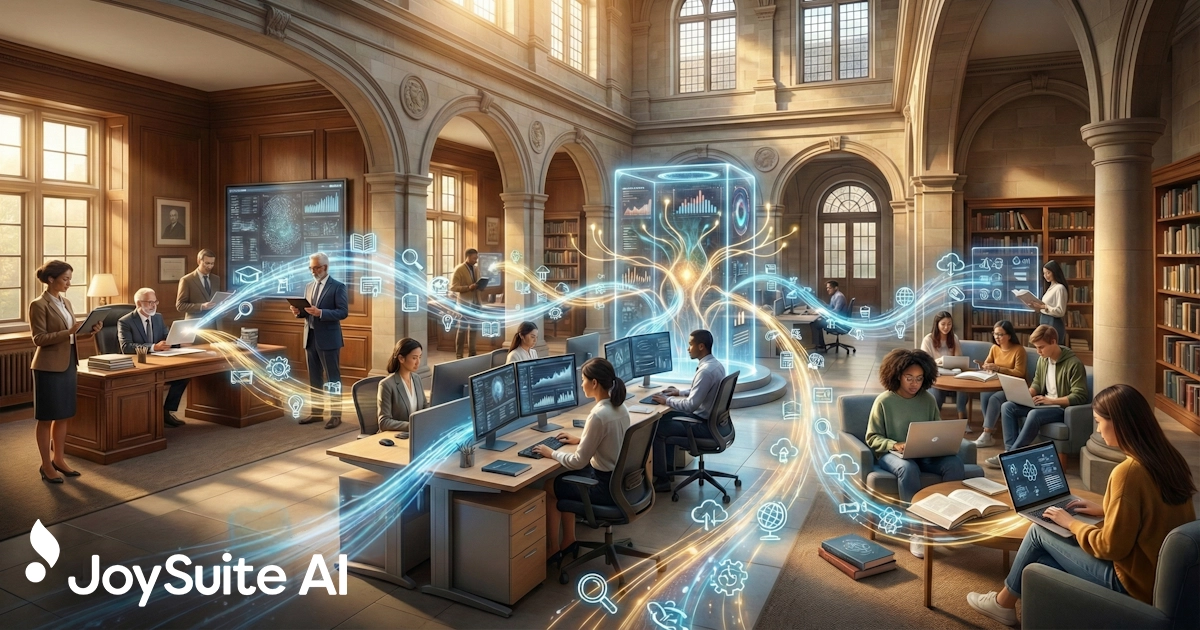
- Use AI as a unifying layer that lets faculty, staff, and students ask questions and get answers drawn from scattered policies across decentralized departments.
- AI acts as a unifying layer, allowing users to ask questions and receive answers drawn from scattered policies and procedures
- This preserves institutional memory and reduces the administrative burden on support staff
- Different audiences have different needs, but AI can serve all three groups from a unified knowledge base
Universities are knowledge institutions that often struggle with knowledge management.
This sounds like a contradiction, but anyone who's worked in higher education recognizes it immediately.
The mission is creating and transmitting knowledge. The operational reality is information scattered across dozens of systems, policies that nobody can find, procedures that vary by department, and institutional knowledge that exists primarily in the heads of people who've been around long enough to know how things work.
A common scenario: A faculty member is trying to understand the sabbatical policy. A staff member is navigating procurement procedures. A student is figuring out how to add a minor or appeal a grade. Each of them enters a maze of websites, PDFs, email chains, and phone calls—often ending with someone who tells them "you actually need to talk to this other office."
The knowledge exists. It's just not accessible in any coherent way.
Higher education has a particularly challenging version of the knowledge problem
Universities are decentralized by design. Academic departments operate with significant autonomy. Administrative units have their own procedures. Different schools within a university may have different policies.
This decentralization serves academic freedom and allows adaptation to disciplinary needs—but it creates fragmentation. This is a more acute version of the institutional knowledge problem that affects all organizations.
Information is distributed across hundreds of websites, each maintained by different units with different approaches. The main university website. Department sites. Individual office pages. Learning management systems. Student portals. HR systems. Finance systems.
Some information is duplicated across sites, sometimes consistently, sometimes not.
Governance is complex. Who decides what, and what policies apply in which situations, isn't always clear. A question that seems simple—can I do this?—often requires understanding which policies apply and who has authority.
Turnover is constant. Students cycle through every four years. Staff turnover is significant. Even faculty, more stable, rotate through administrative roles. Institutional memory is always walking out the door.
The people who know how things really work—the long-tenured staff members, the department administrators who've seen everything—become essential navigators. But their knowledge isn't captured anywhere. When they retire, decades of understanding go with them. Organizations need strategies for preserving institutional knowledge before it walks out the door.
What does this cost?
The costs are real but diffuse, which is part of why they persist.
- Time wasted. Faculty spend hours figuring out administrative procedures instead of teaching and research. Staff are navigating bureaucracy when they should be doing their actual jobs. Students are lost in systems they don't understand.
- Inconsistency. The same question gets different answers depending on who you ask. Some people know the shortcuts and workarounds; others don't. Experience with the institution becomes an unfair advantage.
- Frustration. The daily friction of not being able to find information erodes morale. "Why is this so hard?" is a common refrain. The difficulty of simple tasks becomes a grievance that colors the overall experience.
- Errors. When people can't find the right way to do something, they guess. Sometimes they guess wrong. Forms get submitted incorrectly. Deadlines get missed. Policies get violated accidentally.
- Support burden. Every question that someone can't answer themselves becomes a question for someone else. Help desks, department offices, and knowledgeable colleagues absorb the demand—time that could go elsewhere.
None of this shows up on a single budget line. It's distributed across the institution, a tax on everything that happens.
AI can make institutional knowledge accessible
Imagine faculty, staff, and students could simply ask questions and get accurate answers.
"What's the process for requesting a course release?" "How do I get reimbursed for conference travel?" "I'm a junior and want to change my major. What do I need to do?" "When is the deadline for submitting grades, and what system do I use?"
The AI draws on policy documents, procedure guides, website content, HR materials, academic catalogs—all the scattered information that currently requires navigation to find. It synthesizes an answer, with references to the source documents for verification. This is what grounded AI makes possible—answers from your actual content, not AI-generated guesses.
This isn't replacing the humans who support the institution. It's handling the questions that have straightforward answers—the ones that consume time without requiring judgment. Humans can focus on the complex situations, the exceptions, the cases that actually need their expertise.
Breaking down information silos
By unifying access, AI effectively dismantles the silos that naturally form in decentralized institutions. It doesn't matter if the information lives in the Registrar's PDF or the Provost's intranet page; the user experience is seamless. This creates a "virtual centralization" of knowledge without requiring a massive, disruptive reorganization of the university itself.
Different audiences, same problem
Faculty, staff, and students all struggle with institutional knowledge, but their questions differ.
Faculty need administrative information that isn't their core expertise. How do I hire a research assistant? What's the policy on outside consulting? How does the tenure process work? They're experts in their disciplines; they shouldn't have to become experts in university administration.
Staff need procedural clarity across units. When processes span multiple offices—which most do—understanding the full picture is difficult. Each office knows their piece; the staff member needs to understand the whole.
Students need to navigate systems they encounter for the first time. They don't know what they don't know. They're not sure which questions to ask or who to ask them to. The institution is legible to those who've been around; it's opaque to newcomers.
An AI assistant that can answer questions from all three groups—drawing on the relevant policies and procedures for each—creates consistency that doesn't currently exist.
Onboarding becomes sustainable
One of the most knowledge-intensive moments in higher education is onboarding.
New faculty need to understand teaching requirements, research support, governance structures, and countless administrative processes. New staff need to learn their specific role plus the broader institutional context. New students—every fall, thousands of them—need to understand academic requirements, campus resources, student services, and how to get things done.
Traditional onboarding tries to convey all of this upfront. Orientation sessions, welcome materials, and training programs. The information is delivered; how much is retained is another question.
AI-supported onboarding works differently. The foundational orientation still happens—relationships, culture, and context require human interaction.
But the detailed procedural knowledge becomes accessible on demand. When new faculty have questions three weeks after orientation, they can get answers. When students discover mid-semester that they don't understand the withdrawal process, they can find out. This approach can dramatically reduce ramp time for new faculty and staff.
This also reduces the burden on colleagues who currently serve as informal guides. The new person can answer their own questions instead of constantly asking the person down the hall.
Institutional knowledge gets preserved
When a long-tenured staff member retires, what happens to what they know?
In most institutions, the answer is: it leaves with them.
Some might be captured in transition documents, but the deep knowledge—how things really work, what to do in unusual situations, where the unofficial exceptions are—often isn't written down anywhere.
years of institutional knowledge can walk out the door with a single retirement—unless it's captured in systems that persist.
AI systems can help preserve this knowledge. Structured interviews, documented processes, captured expertise—fed into a knowledge base that continues to serve the institution after the individuals are gone.
This isn't about replacing experienced people. It's about ensuring that their accumulated understanding benefits the institution beyond their tenure. The staff member who's navigated every possible exception to the travel policy has valuable knowledge. Capturing it means future staff don't have to rediscover it. Custom virtual experts can serve as always-available resources built from this captured knowledge.
What this looks like in practice
A university implements an AI assistant trained on its policy library, procedure documentation, academic catalog, HR materials, and key website content. It's accessible to faculty, staff, and students through existing portals.
Faculty example: A faculty member planning a research project asks about hiring student employees. The AI explains the process, links to the required forms, and notes the timeline for different appointment types.
Staff example: A staff member processing an unusual expense asks whether it's allowable under university policy. The AI reviews the relevant policies and provides an answer, with the specific policy citations.
Student example: A student confused about general education requirements asks what they still need to complete. The AI explains the requirements and suggests they consult with their advisor for course selection.
The system tracks what questions are being asked. The administration notices confusion around a recently changed policy and realizes their communications didn't reach everyone—insight that shapes how they announce future changes.
The opportunity
Universities exist to create and share knowledge. The irony of struggling with internal knowledge management isn't lost on anyone.
The fix isn't more websites, better search, or another reorganization. It's making institutional knowledge genuinely accessible—asking a question and getting an answer, regardless of which office owns the information or which system it lives in.
AI makes this possible at a scale that manual approaches never could. The knowledge already exists, scattered across the institution. The task is making it findable, useful, and available to everyone who needs it.
JoySuite helps higher education institutions make knowledge accessible. Faculty, staff, and students can ask questions and get accurate answers—drawn from policies, procedures, and institutional documentation. Knowledge management that actually works for how universities operate.