Key Takeaways
- Microlearning evolved from ancient learning principles through CD-ROMs, the internet, and mobile devices—each era making on-demand, bite-sized learning more accessible.
- The shift from CD-ROM to internet to mobile created the infrastructure for on-demand learning
- Consumer behavior changes driven by Google and smartphones made microlearning inevitable
- The "1% of time for learning" research crystallized why traditional training was failing
Several years of research and reporting have documented that employees feel they have little time for learning at work. But digging into this reveals something important: learners don't lack time for learning itself—they lack patience for learning that's cumbersome, irrelevant, or boring.
A look through microlearning's history shows how this insight, combined with evolving technology, created the conditions for a new approach to workplace learning.
Learning in Increments Is Ancient
The first thing to recognize is that microlearning isn't actually new. Learning step by step, bit by bit, reflects how humans have always learned. The ancient Greek concept of "enkyklios paideia"—the cycle of knowledge—recognized that education builds progressively.
What we call microlearning is the application of tried-and-true incremental learning principles to digital tools and modern work contexts. The principles are old; the implementation is new.
Apprenticeships, tutoring, coaching—these traditional learning methods all involve incremental skill-building. The master craftsperson doesn't lecture for hours; they demonstrate, correct, and gradually transfer knowledge through practice.
The Early Days of Electronic Learning
Computer-based training began in the 1960s, when computers filled entire rooms and only experts could operate them. These early experiments laid groundwork but had little immediate practical impact on workplace learning.
Modern eLearning didn't gain traction until personal computers became common office tools in the late 1980s. CD-ROM-based training emerged as an alternative to expensive instructor-led programs. The key advantage was scalability—unlike in-person training, electronic training could reach additional learners without proportionally increasing costs.
But these early eLearning courses inherited the structure of classroom training. Long, comprehensive modules covering entire topics. Linear progression through predetermined content. Everyone getting the same material in the same order.
The Internet and LMS Era
As networking advanced in the 1990s, the SCORM standard emerged to enable tracking learner progress. Organizations could now see who had completed training, how long they spent, and what their quiz scores were.
This era saw the rise of the Learning Management System—central repositories where employees could find courses on every imaginable topic. Yet these early systems often created the L&D bottleneck we still see today. Vast catalogs offered hundreds of options. But learners could only browse by title or topic; they couldn't search within courses or find specific pieces of information.
The courses themselves remained long and comprehensive. Designers emphasized thorough coverage of topics, with multiple chapters or sections that might take an hour or more to complete. Quizzes at the end measured completion, and organizations tracked completions as the primary metric of training success.
When Technology Outpaced Training
While corporate training evolved slowly, consumer technology leaped ahead. The early 2000s brought several seismic shifts in how people found and consumed information.
Google transformed information-seeking behavior. By 2005, Google had become dominant, and people had learned to search for answers to specific questions. Rather than reading entire reference books, they searched, found what they needed, and moved on.
YouTube exploded after launching in 2005. Suddenly anyone could create and share video content. People started looking to video for how-to guidance on everything from cooking to car repair. Short, focused videos became a primary way people learned outside of work.
The iPhone, released in 2007, put internet access in everyone's pocket. Smartphones became tools for instant information access. Twitter normalized brief content consumption. In a few short years, consumer expectations for how information should be delivered completely transformed—while corporate training largely stayed the same.
The Consumer Learning Revolution
While corporate training departments were still building hour-long courses, consumer learning was transforming. Khan Academy exploded in popularity starting around 2008, offering short video lessons to anyone with internet access. The success proved that millions of people would voluntarily learn through brief, focused content.
Language learning apps like Duolingo applied game mechanics to daily practice sessions of just minutes. Users built skills through consistent brief engagement rather than occasional long sessions. The spaced repetition principles were well-established in learning science; the mobile app made them practical for mass adoption.
MOOCs—Massive Open Online Courses—emerged from universities and reached millions. While many MOOCs used longer formats, they also experimented with chunked content and self-paced learning that influenced corporate training thinking.
The "1% Problem" Becomes Visible
The average time per week employees spent on formal learning—just 1% of a typical work week. If employees only had minutes for training, comprehensive hour-long courses were obviously mismatched to reality.
This framing crystallized the challenge. Either learning had to fit into those available minutes, or it had to become embedded in work itself rather than separate from it.
The research also revealed that employees were constantly learning informally. They asked colleagues questions. They searched online for solutions. They experimented and figured things out. It wasn't that they weren't learning—it was that they weren't using the formal training organizations provided.
The Term "Microlearning" Emerges
The term itself appeared gradually. Around 2006, learning experts began calling for "nano-learning" that could happen every day rather than only in scheduled training events. By around 2009, "microlearning" became more common, and early dedicated platforms began emerging.
These early microlearning platforms distinguished themselves from traditional LMS approaches by emphasizing brief content, mobile access, and modern user experiences. They positioned themselves as alternatives to the click-through eLearning that employees dreaded.
By the mid-2010s, microlearning had become a recognized category in the corporate learning market. Research reports and industry conferences featured it prominently. Organizations began experimenting with and adopting microlearning approaches.
The Integration of Learning Science
As microlearning matured, platforms began incorporating learning science more systematically. Spaced repetition, long validated in research, became a practical feature. Adaptive algorithms personalized content to individual learners. Gamification elements increased engagement.
Spaced repetition research dates back to Hermann Ebbinghaus in the 1880s. The principles aren't new—but microlearning platforms made applying them practical at scale, automating what previously required manual scheduling and tracking.
The combination of brief, focused content with scientifically-grounded delivery methods produced results that attracted more attention and adoption.
Learning in the Flow of Work
A pivotal concept emerged: learning in the flow of work. Rather than treating training as separate from work—something employees must stop working to do—learning could be integrated into work itself.
| CD-ROM Era Training | Modern Microlearning |
|---|---|
| Scheduled computer time in a training room | Any device, anywhere, any time |
| Hour-long comprehensive courses | Brief, focused units on specific topics |
| Same content for everyone | Adaptive, personalized paths |
| Completion as the primary metric | Mastery and retention over time |
| Separate from daily work | Embedded in the workflow |
Performance support—accessing information at the moment of need—became recognized as a legitimate learning approach. Instead of training people on everything they might ever need, organizations could provide searchable resources that employees accessed when questions actually arose.
Where History Points
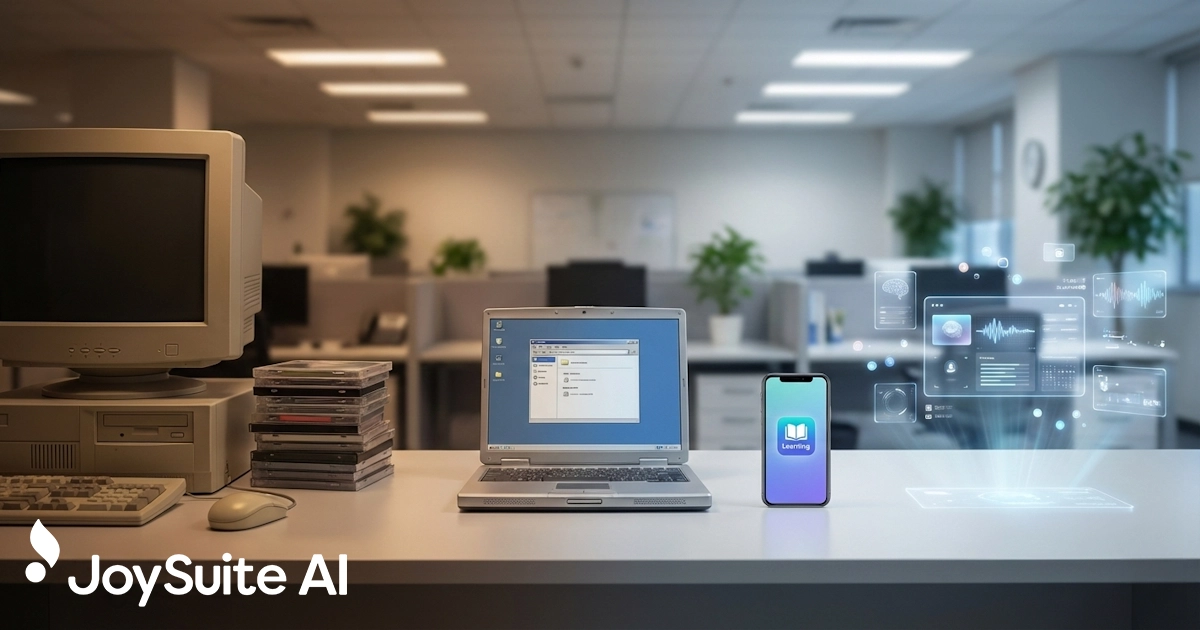
The trajectory is clear. Learning has moved from lengthy, scheduled, location-dependent events toward brief, on-demand, anywhere-accessible resources. This movement parallels how people access information in every other domain of their lives.
How far has your organization moved along this trajectory—from scheduled training events to on-demand, workflow-embedded learning?
The underlying learning science hasn't changed—people still learn incrementally, benefit from practice and repetition, and need relevance to engage. Understanding why employees forget training illuminates why microlearning's approach works. What's changed is the practical ability to apply these principles through technology that fits how people live and work.
Understanding this history clarifies why microlearning resonates. It's not a fad or marketing gimmick—it's the natural application of enduring learning principles to modern technological and workplace realities.
JoySuite represents the next evolution in workplace learning—AI-powered search that finds answers instantly, spaced repetition that builds lasting retention, and integration with the tools your team already uses. The history of microlearning led here: learning that works the way people work.