Key Takeaways
- Traditional knowledge bases return documents; AI-powered knowledge bases return answers—a fundamental shift in the user experience.
- The technology behind AI knowledge bases (RAG architecture) grounds AI responses in your actual content, preventing hallucination.
- AI understands natural language, meaning employees can ask questions like they'd ask a colleague instead of constructing search queries.
- Source citations are critical—they let employees verify answers and build trust in AI-generated responses.
- AI amplifies content quality: good content becomes more accessible, but outdated or contradictory content creates worse problems.
Something fundamental is changing in how organizations manage internal knowledge. For decades, internal knowledge bases have worked the same way: store documents, help employees search for them, hope they find what they need.
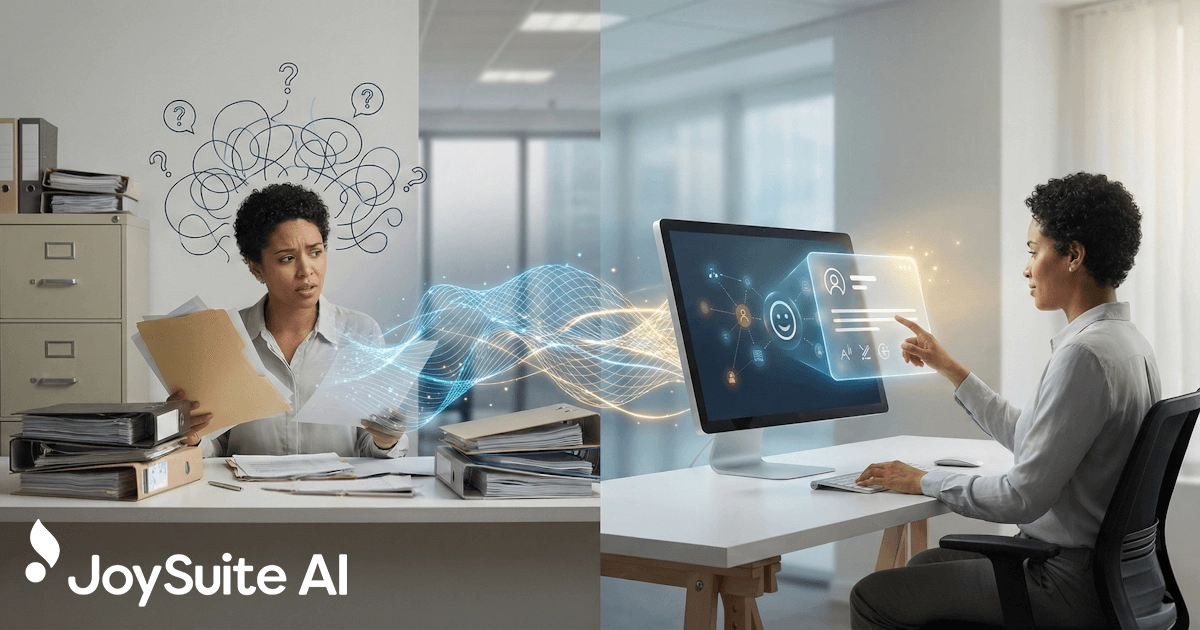
AI changes the model. Instead of returning a list of documents for employees to read through, AI-powered knowledge bases understand questions and return answers—synthesized from your actual content, with citations you can verify.
This isn't incremental improvement. It's a different paradigm entirely. And understanding the difference matters, whether you're evaluating new tools or considering how to enhance existing systems.
What Is the Fundamental Shift from Search to Answers?
AI-powered knowledge bases replace the traditional search-and-read workflow with direct, synthesized answers, reducing time-to-answer from minutes to seconds.
Consider how traditional knowledge bases work:
- Employee has a question: "How much parental leave do I get?"
- Employee translates question into search terms: "parental leave policy"
- System returns documents containing those terms: 8 results
- Employee opens documents, scans for relevance, reads through
- Employee (maybe) finds the answer after 5-10 minutes
Now consider how AI-powered knowledge bases work:
- Employee asks a question: "How much parental leave do I get as a birth parent with 3 years of tenure?"
- System understands the question, finds relevant content, synthesizes an answer
- Employee receives: "As a birth parent with 3+ years of tenure, you're eligible for 18 weeks of paid leave..." with a link to the source policy
- Employee has their answer in seconds
Difference in time to answer between traditional search (5+ minutes) and AI-powered answers (30 seconds). The productivity impact compounds across every employee, every question, every day.
The shift isn't just faster—it's fundamentally different. This is how AI knowledge assistants deliver real value. Employees no longer need to translate their questions into search-friendly terms, navigate document structures, or synthesize information themselves. They just ask.
How Do AI Knowledge Bases Work?
AI knowledge bases use Retrieval-Augmented Generation (RAG) to semantically search your content, retrieve relevant passages, and generate natural-language answers grounded in your actual documents.
Understanding the technology helps set realistic expectations about what AI can and can't do.
Retrieval-Augmented Generation (RAG)
Most AI knowledge bases use an architecture called Retrieval-Augmented Generation, or RAG. The name describes exactly what happens:
Retrieval: When an employee asks a question, the system searches your knowledge base for relevant content. This isn't keyword matching—it's semantic search that understands meaning. "How much vacation do I get?" finds content about PTO policies even if the word "vacation" doesn't appear.
Augmentation: The retrieved content becomes context for the AI. Instead of the AI answering from its general training (which knows nothing about your specific policies), it answers based on your actual documents.
Generation: The AI synthesizes a natural-language response based on the retrieved content. It's not copy-pasting paragraphs—it's understanding the content and generating a helpful answer.
Traditional AI (no RAG): "Parental leave policies vary by company. Typically, companies offer 4-16 weeks..." (Generic, not useful)
RAG-powered AI: "According to your Parental Leave Policy (updated January 2026), birth parents with 3+ years of tenure receive 18 weeks of paid leave, which can be taken consecutively or split..." (Specific, accurate, citable)
Why Citations Matter
A critical feature of well-designed AI knowledge bases is source citation. Every answer should point to where the information came from.
Citations serve multiple purposes:
- Verification: Employees can check that the AI got it right
- Deep dives: Users who need more context can read the full source
- Trust building: Seeing that answers come from real documents builds confidence
- Accountability: If an answer is wrong, you can trace it to the source content
Without citations, employees have to trust AI blindly. That trust erodes quickly after the first wrong answer. With citations, even occasional errors don't destroy credibility—employees can verify when it matters.
Understanding Context and Intent
Traditional search matches keywords. AI understands meaning.
| Query | Traditional Search | AI Understanding |
|---|---|---|
| "PTO balance" | Documents containing "PTO" and "balance" | User wants to know their current vacation time remaining |
| "Do I get time off for a funeral?" | May miss content titled "Bereavement Leave" | Understands this is about bereavement leave policies |
| "What's our policy on WFH?" | Requires "WFH" to appear in documents | Knows WFH = work from home = remote work policy |
| "Can I bring my dog to work?" | Searches for "dog" and "work"—random results | Looks for pet policy, office rules, workplace guidelines |
This understanding of intent is transformative. Employees don't need to guess the right terminology or know how documents are titled. They ask naturally, and the AI figures out what they need.
What Capabilities Do AI-Powered Knowledge Bases Enable?
AI-powered knowledge bases unlock natural language queries, multi-source synthesis, conversational follow-up, and multilingual access that traditional systems cannot match.
The technology enables capabilities that traditional systems can't match.
Natural Language Queries
Employees ask questions like they'd ask a knowledgeable colleague:
- "What happens to my health insurance if I take a leave of absence?"
- "How do I expense a client dinner?"
- "What's the process for requesting a transfer to another office?"
No query syntax. No Boolean operators. No guessing the right keywords. Just questions.
Multi-Source Synthesis
Some questions can't be answered from a single document. "What do I need to know before starting parental leave?" might require combining:
- Leave duration and pay from the parental leave policy
- Benefits continuation from the HR handbook
- Manager notification requirements from the manager guide
- Return-to-work procedures from the onboarding documentation
AI can synthesize across sources, providing a comprehensive answer that would take an employee significant time to compile manually.
Conversational Follow-Up
Real questions rarely stand alone. After asking about parental leave, an employee might follow up:
- "Does that apply to adoptive parents too?"
- "What if I want to extend my leave?"
- "Who do I contact to start the process?"
AI maintains context from previous questions, understanding that "that" refers to the parental leave policy just discussed. This enables natural, efficient interactions rather than starting from scratch with each question.
Multilingual Capabilities
Global organizations face a choice: translate all documentation into every language or leave non-English speakers underserved. AI offers a third option.
Advanced AI systems can answer questions in any language, drawing from source content in any language. An employee in Brazil can ask in Portuguese and receive an answer synthesized from English policy documents. The AI handles translation seamlessly.
Note: Quality varies by language pair and complexity. Critical content should still be professionally translated, but AI dramatically expands access for everyday questions.
AI-Powered vs. Traditional Knowledge Bases
Understanding the differences helps set expectations and inform decisions.
| Capability | Traditional Knowledge Base | AI-Powered Knowledge Base |
|---|---|---|
| Query interface | Keyword search, category browsing | Natural language questions |
| Results format | List of documents to review | Synthesized answer with citations |
| Multi-source answers | User must find and combine manually | Automatic synthesis across sources |
| Synonym handling | Requires configuration or luck | Automatic semantic understanding |
| Conversation context | Each search starts fresh | Maintains context for follow-ups |
| Content structure needs | Critical—findability depends on organization | Less critical—AI handles navigation |
| Content quality needs | Important for usefulness | Critical—AI amplifies quality issues |
When Traditional Makes Sense
AI-powered knowledge bases aren't always the answer:
- Browsing use cases: Sometimes employees want to explore, not ask specific questions. "What policies do we have?" is better served by browsable categories.
- Document access: When employees need the actual document (for signatures, forms, or printing), they need to find the file, not get an answer about it.
- Audit requirements: Some compliance scenarios require proof that employees accessed the specific authoritative document.
Many organizations use both: AI for quick answers, traditional access for document retrieval and browsing.
Why Is Content Quality Critical for AI Knowledge Bases?
AI amplifies whatever content you feed it, making good content dramatically more accessible while making outdated or contradictory content produce confidently wrong answers.
Here's the uncomfortable truth about AI-powered knowledge bases: they amplify your content problems.
AI Can't Fix Bad Content
If your policies contradict each other, AI might cite either one—or try to reconcile them in confusing ways. If your documents are outdated, AI will confidently serve outdated information. If you have three versions of the same procedure, AI might mix them together. This is why knowledge silos cost more than you think.
AI makes good content great and bad content worse. Before investing in AI-powered search, invest in content quality. Audit for accuracy, eliminate contradictions, archive the outdated.
What Quality Means for AI
Content that works for AI-powered knowledge bases:
- Current: Recently reviewed and verified accurate
- Authoritative: One source of truth per topic, not multiple conflicting documents
- Complete: Answers the full question, not just part of it
- Clear: Unambiguous language that AI can interpret correctly
- Findable: Exists somewhere in your connected systems (can't answer from content that isn't indexed)
Continuous Content Improvement
AI knowledge bases generate valuable signals about content quality:
- Questions with poor answers indicate content gaps or quality issues
- Low-rated responses pinpoint problematic content
- Frequently asked questions with no good answer reveal documentation needs
Use these signals to continuously improve. The AI gets better as your content gets better.
What Should You Consider When Implementing an AI Knowledge Base?
Successful implementation requires attention to integration depth across your content sources, proper permission management, accuracy monitoring, and setting appropriate user expectations.
Organizations adopting AI-powered knowledge bases should consider:
Integration Depth
Where does your knowledge currently live? The value of AI-powered search increases with the breadth of content it can access:
- Policy documents in SharePoint
- Procedures in Confluence
- FAQs in help desk systems
- Product information in wikis
- Training materials in LMS
The more sources connected, the more comprehensive the AI's knowledge—and the more useful its answers. This is why universal connectors matter.
Permission Management
AI must respect access controls. When an employee asks a question:
- AI should only search content that employee can access
- Answers shouldn't reveal information from restricted documents
- Citations should only point to accessible content
Verify that any AI knowledge system properly inherits permissions from source systems.
Accuracy Monitoring
AI occasionally gets things wrong. Build processes to catch and correct errors:
- Easy feedback mechanisms for users to flag incorrect answers
- Regular review of low-rated responses
- Spot-checking of answers on critical topics
- Clear escalation path when AI can't help
User Expectations
Set appropriate expectations during rollout:
- AI works best for documented, factual questions
- Complex judgment calls still need human experts
- Answers should be verified when stakes are high
- Feedback improves the system over time
The Future of AI Knowledge Bases
The technology continues to evolve rapidly:
Agentic capabilities. Beyond answering questions, AI systems are starting to take actions—scheduling meetings, submitting requests, updating records. The line between knowledge assistant and task automation is blurring.
Proactive answers. Instead of waiting for questions, AI may surface relevant information based on context—what you're working on, what meeting you're preparing for, what decisions you need to make.
Deeper personalization. Systems are getting better at understanding who's asking and tailoring responses to their role, location, tenure, and past questions.
Improved reasoning. New models show better ability to handle complex, multi-step questions that require logical reasoning, not just information retrieval.
Getting Started
If you're considering an AI-powered internal knowledge base:
Start with content quality. Audit existing documentation. Resolve contradictions. Archive the outdated. AI will amplify whatever you feed it.
Define success metrics. What does good look like? Ticket deflection? Time to answer? User satisfaction? Define before you implement.
Pilot before scaling. Start with one department or use case. Learn what works before rolling out company-wide.
Plan for hybrid. AI-powered answers and traditional document access often coexist. Don't force everything through one interface.
Invest in feedback loops. The system improves through use. Make it easy to report problems and act on that feedback.
AI-powered knowledge bases represent a genuine advancement in how organizations can make knowledge accessible. For those ensuring AI responses are accurate, understanding grounded AI is essential. The shift from search to answers—from documents to intelligence—fundamentally changes what employees can expect when they need information.
But the technology is a tool, not a solution. Success still depends on content quality, governance, and organizational commitment to making knowledge accessible. AI makes good knowledge management dramatically better. It can't compensate for its absence.
JoySuite delivers AI-powered answers from your organization's knowledge. Employees ask questions in plain language and get instant answers with citations—no searching through documents, no hoping you found the right one. With connections to your existing systems, your knowledge becomes genuinely accessible.