Key Takeaways
- AI learning platforms don't just deliver content—they create training from existing documents, fundamentally changing L&D capacity
- The shift from content consumption to content creation represents the biggest change in corporate training since the move from classroom to digital
- AI-native platforms outperform legacy LMS systems with AI features bolted on—architecture matters
- Look for platforms that verify mastery rather than just track completions, addressing the core problem with traditional eLearning
- No per-seat pricing models eliminate the adoption barrier that has limited AI tool rollout across enterprises
For two decades, learning management systems have operated on the same basic premise: someone creates content, uploads it to the LMS, assigns it to employees, and tracks who clicked through it. The platforms got prettier. The reporting got fancier. But the fundamental model—create, upload, assign, track—remained unchanged.
That model is breaking down.
Organizations are drowning in training requests they can't fulfill. L&D teams report backlogs of 50, 100, even 200 training projects they'll never get to. Meanwhile, the training they do deliver often fails to produce lasting behavior change. Employees click through slides, pass knowledge checks, and forget everything within weeks.
AI learning platforms represent a fundamental rethinking of how corporate training works. Not a feature upgrade to the existing model—a different model entirely.
What Is an AI Learning Platform?
An AI learning platform is a training system where artificial intelligence is central to how the platform operates, not just an add-on feature. The distinction matters more than it might seem.
A traditional LMS with AI features might use machine learning to recommend courses based on what similar employees took. Useful, but incremental. The core workflow—create content manually, upload it, assign it—remains unchanged.
AI learning platforms don't just recommend content. They create it. That shift—from content consumption to content creation—changes everything about what's possible in corporate training.
An AI-native learning platform uses AI throughout the learning lifecycle:
- Content creation: Transform existing documents into quizzes, scenarios, and interactive learning
- Personalization: Adapt what each learner sees based on their demonstrated knowledge and gaps
- Assessment: Generate questions and evaluate responses intelligently
- Analytics: Identify patterns in learning data that humans would miss
- Support: Answer learner questions from organizational knowledge bases
The result is a platform that can do in minutes what previously took weeks—and can scale in ways that traditional approaches never could.
How Does AI Transform Traditional LMS Capabilities?
To understand why AI learning platforms matter, consider how they change each core LMS function.
How AI Reduces Training Content Creation From Months to Minutes
Traditional training development is painfully slow. Industry benchmarks suggest 40-200 hours of development time per finished hour of eLearning. A 30-minute compliance module might take a skilled instructional designer weeks to build.
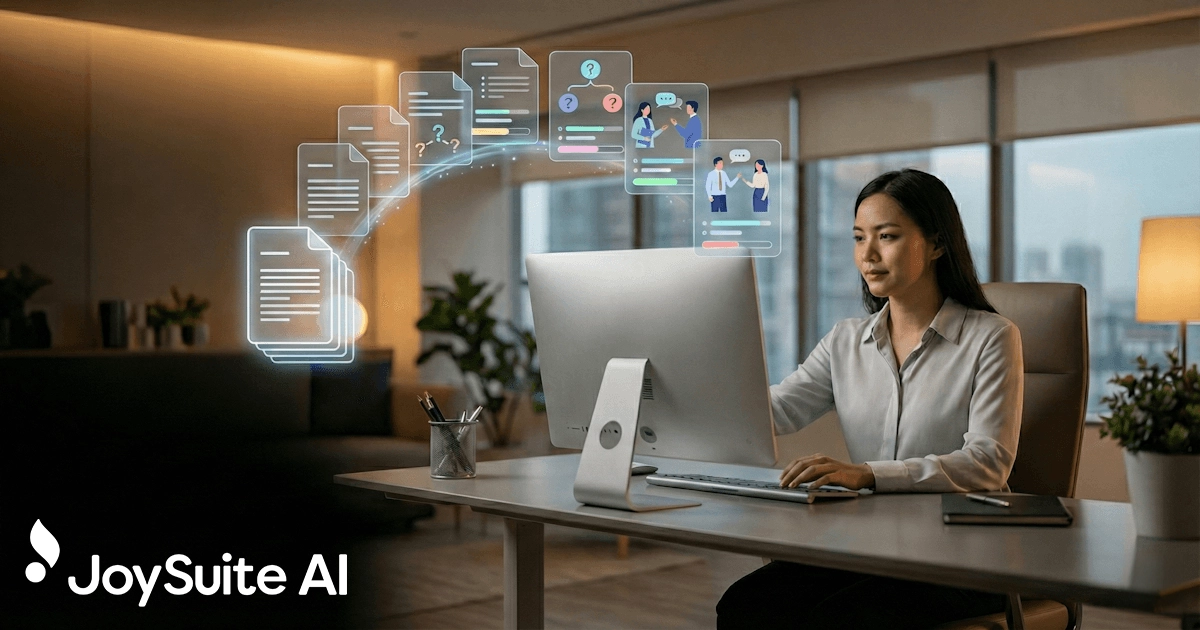
AI learning platforms flip this equation. Upload a policy document, product guide, or process manual—and generate training in minutes. Not perfect training that requires no review. But a solid first draft that humans can refine, rather than building from scratch.
reduction in content creation time is commonly reported when moving from traditional authoring to AI-assisted creation—transforming what took weeks into hours.
(Estimated based on early adopter reports)This speed advantage compounds over time. When content changes, regenerating training from updated source documents takes minutes. Maintaining a course built in traditional authoring tools means finding the project file, locating the relevant slides, making changes, republishing, and redistributing. AI platforms eliminate most of that maintenance burden.
Why Personalized Content Delivery Outperforms One-Size-Fits-All Training
Traditional LMS platforms assign the same course to everyone. An employee with ten years of experience gets the same content as a new hire. Someone who already knows 80% of the material sits through the same training as someone starting from zero.
AI learning platforms adapt to individual learners. They can:
- Assess existing knowledge before training begins
- Skip content the learner already knows
- Provide additional practice on weak areas
- Adjust difficulty based on demonstrated mastery
- Recommend next steps based on performance and role
The result is training that respects learners' time while ensuring everyone reaches competency. No more forcing experts through basics. No more leaving struggling learners behind.
How AI Assessment Moves Beyond Multiple Choice to Mastery Verification
Traditional eLearning assessment is broken. Employees learn to game multiple-choice questions. They click through content just fast enough to reach the quiz, take it until they pass, and promptly forget everything. The forgetting curve is brutal—most training content is lost within weeks.
Completion rates measure exposure, not learning. An employee who completed training and forgot it all counts the same as one who genuinely mastered the material. Traditional LMS metrics often hide this reality.
AI learning platforms enable fundamentally different assessment approaches:
- Generated assessments: AI can create unlimited question variations from source material, making memorizing answer keys impossible
- Scenario-based evaluation: Roleplay conversations with AI to demonstrate skills in realistic situations
- Spaced practice: Resurface content at optimal intervals for long-term retention
- Performance analytics: Track not just whether someone passed, but whether they retained knowledge over time
The goal shifts from "did they complete it?" to "do they actually know it?"—a question traditional LMS platforms struggle to answer.
What Makes AI Learning Analytics Better Than Completion Reports?
Traditional LMS analytics focus on vanity metrics. Completion rates. Time spent. Quiz scores. These numbers look good in reports but tell you little about whether training actually worked.
AI learning platforms can analyze learning data at a depth humans can't match:
- Which specific concepts cause the most confusion across the organization
- How knowledge retention varies by department, role, or training format
- Which content elements correlate with actual on-the-job performance
- Where knowledge gaps exist before they cause problems
This intelligence enables continuous improvement. Instead of guessing what training to prioritize, L&D teams can see exactly where knowledge gaps exist and address them proactively.
How Do Traditional LMS and AI-Native Platforms Compare?
The differences between traditional and AI-native learning platforms go beyond features. They reflect fundamentally different philosophies about how corporate training should work.
| Dimension | Traditional LMS | AI Learning Platform |
|---|---|---|
| Content creation | Manual development with authoring tools (weeks-months) | AI-generated from existing documents (minutes-hours) |
| Content updates | Rebuild courses when content changes | Regenerate from updated source documents |
| Personalization | Same course for everyone | Adaptive paths based on individual knowledge |
| Assessment | Static quizzes, easy to game | Dynamic assessment, mastery verification |
| Who creates content | L&D specialists only | Anyone with subject expertise |
| Scaling capacity | Linear—more content requires more headcount | Exponential—AI amplifies existing capacity |
| Primary metric | Completion rates | Demonstrated competency |
| Maintenance burden | High—courses need constant updates | Low—regenerate from source |
For a deeper exploration of these differences, see Traditional LMS vs AI Learning Platform: What's Actually Different.
What AI Features Should You Evaluate in a Learning Platform?
Not all AI learning platforms are created equal. When evaluating options, look for these capabilities:
How Well Does the Platform Convert Documents to Training?
The core value proposition of AI learning platforms is transforming existing knowledge into training. Evaluate how well each platform handles:
- Source formats: Can it process PDFs, Word docs, presentations, videos, web pages?
- Output types: Does it create quizzes, scenarios, flashcards, coaching sessions?
- Quality: How much editing do generated materials require?
- Accuracy: Does it faithfully represent source content or introduce errors?
Test with your actual content. Generic demos look great; real-world documents reveal limitations. Upload your most challenging policy document and see what comes out.
Does the Platform Support Conversational and Dialogue-Based Learning?
AI enables learning through dialogue, not just content consumption. Look for:
- Roleplay scenarios: Practice conversations with AI playing customer, employee, or stakeholder roles
- Coaching interactions: Work through problems with AI guidance
- Q&A capability: Ask questions about training content and get accurate, cited answers
How Does the Platform Prevent AI Hallucination and Ensure Accuracy?
AI that answers questions must be grounded in your organization's actual knowledge—not generic internet training data. Evaluate:
- Source citation: Does the AI show where answers come from?
- Accuracy controls: How does the platform prevent AI hallucination?
- Knowledge boundaries: Does the AI stay within your approved content?
What Integration Capabilities Should an AI Learning Platform Offer?
AI learning platforms work best when connected to your broader ecosystem:
- Content sources: Can it connect to SharePoint, Google Drive, Confluence, and other document repositories?
- HRIS integration: Can it pull employee data for role-based training assignment?
- Communication tools: Does it work within Slack, Teams, or other platforms employees already use?
- SSO: Does it support your identity management approach?
What Analytics and Reporting Go Beyond Completion Tracking?
Beyond completion tracking, evaluate:
- Knowledge gap identification: Can you see where employees struggle?
- Retention tracking: Does the platform measure knowledge over time, not just immediately after training?
- ROI metrics: Can you connect learning activity to business outcomes?
For a complete evaluation framework, see How to Choose an AI Learning Platform: Buyer's Checklist.
Should You Prioritize Content Creation or Content Consumption in an AI LMS?
The most important distinction in AI learning platforms is whether they focus primarily on content creation or content consumption.
What Do Consumption-Focused AI Learning Platforms Offer?
Some AI platforms enhance how learners consume existing content:
- AI-powered search across course libraries
- Personalized recommendations based on role or history
- Chatbots that answer questions about course content
- Adaptive sequencing through existing materials
These features add value. But they don't solve the fundamental problem: you still need to create all the content. If your L&D team can't keep up with demand today, consumption-focused AI won't change that.
How Do Creation-Focused AI Platforms Solve the L&D Bottleneck?
Creation-focused AI platforms address the bottleneck directly. This is central to AI training content creation:
- Transform documents into interactive training
- Generate assessments from source material
- Create roleplay scenarios from process documentation
- Enable subject matter experts to produce training without L&D involvement
This approach changes L&D capacity fundamentally. Instead of being limited by how many courses designers can build, you're limited only by how much knowledge exists in your organization—and most organizations have far more documented knowledge than they've converted to training.
The organizations with the biggest training backlogs often have the most documented knowledge. They don't have a content problem—they have a conversion problem. AI solves that.
Why Do the Best AI Platforms Blend Content Creation and Consumption?
The best AI learning platforms do both. They create content from existing sources AND enhance how learners consume it. Creation without good delivery wastes the content you produce. Consumption without creation leaves you stuck with the same capacity constraints.
How Do AI-Powered Personalized Learning Paths Work?
Personalization is one of AI's clearest advantages in learning—but implementations vary widely.
What Is Role-Based Training Assignment (Basic Personalization)?
The simplest form assigns different training tracks based on role or department. A salesperson sees sales training; an engineer sees technical training. This isn't really AI—it's rules-based assignment with a marketing label.
How Does AI-Powered Content Recommendation Personalize Training?
More sophisticated platforms recommend content based on:
- What similar employees have taken
- Skills gaps identified in assessments
- Career development goals
- Performance data from integrated systems
This works but still relies on employees choosing to engage with recommendations. Many won't.
What Is Adaptive Learning and Why Does It Produce Better Outcomes?
True adaptive learning adjusts the experience in real-time based on demonstrated knowledge:
- Pre-assess to identify what the learner already knows
- Skip content where mastery is demonstrated
- Provide additional practice where gaps exist
- Adjust question difficulty based on performance
- Resurface content for long-term retention
This respects learners' time while ensuring everyone reaches competency, addressing what makes traditional training ineffective. An expert might complete training in 10 minutes. A novice might need an hour. Both finish knowing what they need to know.
True adaptive learning requires substantial content depth. The platform needs alternative explanations, varied examples, and multiple difficulty levels to adapt effectively. Evaluate whether platforms actually deliver adaptivity or just claim it.
What Is the Difference Between AI-Native and AI-Bolted-On Learning Platforms?
As AI becomes a marketing imperative, every LMS vendor claims AI capabilities. The distinction between AI-native and AI-added matters.
What Defines an AI-Native Learning Platform?
Built from the ground up with AI as a core architectural component:
- AI is central to the product experience, not optional
- The platform was designed around AI capabilities
- AI improvements benefit all users automatically
- Integration between AI features is seamless
What Are the Limitations of AI-Bolted-On LMS Platforms?
Traditional LMS platforms that have added AI features:
- AI features feel separate from core functionality
- Legacy architecture may limit what AI can do
- AI often requires separate licensing or add-on fees
- Features may not integrate well with each other
The distinction matters because architecture constrains possibility. A platform designed before AI can add features, but redesigning the core experience is difficult. AI-native platforms can evolve faster because they don't carry legacy constraints.
For more on this distinction, see LMS with AI Features vs AI-Native Learning Platforms.
What Are the Top AI Learning Platform Categories in 2026?
The AI learning platform market is evolving rapidly. Major categories include:
Which AI-Native Platforms Lead the Market?
Platforms built from the ground up around AI capabilities. These typically excel at content creation and offer the most innovative features, but may have less mature enterprise features than established LMS vendors.
How Do Traditional LMS Vendors Add AI Features?
Established players like Cornerstone, Docebo, and Absorb have added AI capabilities. They offer mature enterprise features, broad integrations, and proven scalability—but AI often feels like an add-on rather than a core capability.
When Should You Consider Specialized AI Learning Point Solutions?
Specialized tools that focus on specific AI use cases: quiz generation, video analysis, coaching bots. These can integrate with existing LMS platforms but add complexity to the technology stack.
For detailed comparisons with specific platforms, features, and pricing considerations, see Best AI-Powered LMS Software in 2025.
How Should You Plan an AI Learning Platform Implementation?
Adopting an AI learning platform involves more than technology selection.
How Do You Assess Content Readiness for AI Training Conversion?
AI learning platforms transform existing content. If your organizational knowledge exists only in employees' heads, you'll need to capture it first. Evaluate:
- What documentation already exists?
- How current and accurate is it?
- What knowledge gaps need to be filled?
- Who owns maintaining this content?
Start by inventorying existing documentation. Most organizations have more than they realize—policy manuals, process guides, product documentation, training materials. AI can transform all of it.
What Change Management Is Needed When Adopting an AI Learning Platform?
AI learning platforms change how multiple groups work:
- L&D teams: Shift from content creation to content curation and quality assurance
- Subject matter experts: May create training directly for the first time
- Managers: New capabilities for team-specific training
- Employees: Different learning experience than traditional eLearning
Plan for these transitions. The technology works only if people adopt it.
What Governance Policies Should You Establish for AI-Generated Training?
AI-generated content raises governance questions:
- Who reviews and approves AI-generated training?
- How do you ensure accuracy and appropriateness?
- What content should NOT be AI-generated (e.g., legal disclaimers)?
- How do you handle AI errors when discovered?
Establish clear policies before rollout, not after problems emerge.
How Should You Plan AI Learning Platform Integrations?
Map how the AI learning platform connects to your ecosystem:
- Source systems for content (document repositories, knowledge bases)
- HR systems for employee data
- Communication tools for delivery
- Analytics platforms for reporting
What Success Metrics Should You Track for AI Learning Platforms?
Define what success looks like before implementation:
- Time savings in content creation?
- Reduction in training backlog?
- Improved knowledge retention?
- Employee satisfaction with training?
- Business outcomes affected by training?
Baseline current performance so you can measure improvement.
How Does Organization Size Affect AI Learning Platform Selection?
AI learning platform selection varies by organizational context.
What Should Small Businesses (Under 200 Employees) Look for in an AI LMS?
Small organizations need:
- Fast time to value—no lengthy implementations
- Ease of use without dedicated administrators
- Affordable pricing that scales with headcount
- Core functionality without enterprise complexity
For specific recommendations, see AI LMS for Small Business: Top Options.
What Do Mid-Market Organizations (200-2,000 Employees) Need in an AI LMS?
Growing organizations need:
- Scalability to support growth
- Integration with expanding tech stack
- Role-based access and permissions
- Reporting for multiple stakeholders
What Enterprise Requirements (2,000+ Employees) Matter Most for AI Learning?
Large organizations require:
- Proven scalability and reliability
- Global deployment capabilities (multilingual, multi-region)
- Advanced security and compliance features
- Integration with complex enterprise systems
- Dedicated support and success resources
Enterprise considerations are explored in AI Corporate Training Platform: What Enterprise L&D Teams Need to Know.
What Does the Future of AI-Powered Corporate Training Look Like?
AI learning platforms represent a transition point, not an endpoint. Several trends will shape the next evolution:
How Will AI Learning Integrate Directly Into Daily Workflows?
Learning will increasingly happen inside the tools where work happens—not in separate LMS platforms. AI that surfaces knowledge and training within Slack, Teams, Salesforce, and other work applications will reduce the friction between learning and doing.
How Will Real-Time AI Knowledge Support Replace Traditional Courses?
The line between training and performance support will blur. Instead of completing courses before doing work, employees will access AI-powered guidance while doing work. Just-in-time learning will supplement (and sometimes replace) just-in-case training.
How Will Predictive AI Identify Knowledge Gaps Before They Cause Problems?
AI will identify knowledge gaps before they cause problems. Instead of training everyone on everything, organizations will target training precisely where it's needed—based on actual performance data, not assumptions.
Why Will Continuous Competency Verification Replace Annual Certification?
Point-in-time certification will give way to continuous competency verification. Instead of passing a test once and being certified for a year, employees will demonstrate ongoing mastery through regular, low-friction assessments.
How Will AI Democratize Training Content Creation Across Organizations?
As AI makes training creation accessible to non-specialists, organizations will tap expertise across the organization. Subject matter experts, managers, and even peers will contribute training content at scales impossible with traditional development approaches.
What would your organization look like if anyone with expertise could create training—and every employee had instant access to organizational knowledge exactly when they needed it?
How Do You Transition From a Traditional LMS to an AI Learning Platform?
If you're considering an AI learning platform, start with these steps:
- Audit your current state. What's in your training backlog? Where does knowledge exist in documents but not in training? What are learners' biggest complaints about current training?
- Define success criteria. What problems must the platform solve? What metrics will you use to evaluate success?
- Evaluate options. Focus on platforms that address your specific challenges, not just feature checklists.
- Run a focused pilot. Test with a real use case that matters. Evaluate both the technology and organizational readiness.
- Plan for change. Technology is the easy part. Prepare your L&D team, content owners, and learners for new ways of working.
The transition from traditional LMS to AI learning platform isn't instant. But organizations that make the shift will find themselves able to deliver training at speeds and scales that weren't previously possible—while actually improving learning outcomes.
That's the promise of AI learning platforms: not just faster and cheaper, but genuinely better. Training that employees actually complete. Knowledge that actually sticks. Skills that actually transfer to the job.
The LMS as we've known it is evolving. The organizations that evolve with it will have a significant advantage in developing their workforce for whatever comes next.
JoySuite represents what AI-native learning looks like in practice. Turn any document into training—quizzes, roleplays, coaching sessions, and flashcards—in minutes instead of months. Combined with AI-powered knowledge access that gives employees instant answers from your organizational knowledge base, JoySuite delivers the complete AI learning platform experience. And with unlimited users included, you can deploy to your entire organization without per-seat constraints holding you back.