Practical thinking on learning at work
How teams capture what they know, turn it into real skill, and put it to work every day: field notes on knowledge practice and workplace learning.

The 15 Questions Eating Up Your HR Team's Time
There are certain questions HR answers so often they could do it in their sleep. Here are the 15 most common, and why they don't need a human in the loop.

The Account Handoff Checklist: Sales to CS Transition Done Right
The transition from sales to customer success is where many customer relationships start to wobble. A structured handoff process ensures nothing falls through the cracks and customers feel cared for from the start.

AI Adoption Checklist: 10 Questions to Ask Before You Buy
Successful enterprise AI adoption requires looking past the polished demo to the practical realities of implementation. Here are the ten questions that actually predict whether you'll get value.

How to Build an AI Business Case Your CFO Will Actually Approve
Your CFO has approved plenty of technology investments. The difference with AI is that most business cases rely on hype instead of math. Here's how to build a case that gets to yes.

How AI Chatbots Use Knowledge Bases
AI chatbots are only as good as the knowledge they can access. Here's how the integration actually works, and why it matters for answer quality.

AI Corporate Training Platform: What Enterprise L&D Teams Need to Know
Enterprise organizations face unique challenges when adopting AI learning platforms. Security review takes months. Integrations are complex. Global deployment adds layers of requirements. Here's what large organization L&D teams need to consider.

AI eLearning Authoring Tools vs Traditional Software: Which Is Right for You?
Should you stick with traditional authoring tools or switch to AI-powered platforms? The answer depends on what you're building, who's building it, and how fast you need to move. Here's how to decide.

AI for Employee Benefits Questions: How to Handle the Volume
Benefits questions spike during open enrollment and surge with every life event. AI can handle the routine ones instantly, with accurate, cited answers from your actual benefits documentation.

AI Employee Onboarding: How to Cut Ramp Time in Half
Traditional onboarding leaves new hires waiting for answers and sitting through generic training. AI changes the equation: instant access to knowledge, personalized learning paths, and dramatically faster ramp times.

AI for Franchisors: Consistency at Scale
Franchise inconsistency rarely stems from a lack of standards; it stems from a lack of access to those standards in the moment of need. AI solves this by transforming static operations manuals into an on-demand, conversational knowledge base.

AI HR Software: How to Automate 80% of Employee Questions
HR teams spend hours every week answering the same questions. AI can handle most of them instantly, with accurate, cited answers from your actual policies. Here's how to make it work.

AI for Learning and Development: The L&D Leader's Complete Guide
L&D teams are stretched thin: rising demand, flat budgets, and training backlogs that never shrink. AI offers a path forward: not by replacing L&D professionals, but by amplifying what they can accomplish. This guide covers where AI fits in the L&D workflow, what's working today, and how to implement it successfully.

AI for Manufacturing: Reduce Downtime, Boost Quality, and Train Faster
Manufacturing runs on knowledge: SOPs, machine specs, safety protocols, and decades of operator experience. AI makes that knowledge instantly accessible to every worker on every shift, reducing downtime, improving quality, and cutting training time in half.

AI for Marketing Teams: Practical Applications That Actually Drive Results
Marketing teams are drowning in content demands and data. AI can handle the repetitive work: drafting, segmenting, reporting, so your team focuses on strategy and creativity. Here's what actually works.

AI Governance 101: Building Policies That Enable Rather Than Block
AI governance that focuses only on restriction creates shadow AI. Effective governance protects the organization while enabling employees to get value from AI tools.

AI Healthcare Compliance Training: How to Build Programs That Actually Protect Patients and Staff
Healthcare compliance training fails when it's a check-the-box exercise. AI transforms it into adaptive, role-specific learning that sticks, reducing violations while cutting training time. Here's how to make it work.

AI HR Chatbots: The Complete Guide for 2025
AI HR chatbots have evolved far beyond basic FAQ bots. Modern systems understand natural language, cite sources, and know when to escalate to humans. Here's how they work and how to implement one.

AI in L&D: What's Hype and What's Real
Every vendor in the learning space is talking about AI now. Every product has AI features. Every pitch deck promises transformation. This makes it hard to know what to take seriously.

AI Knowledge Assistants for Customer Support
Customer support teams answer the same questions repeatedly. AI knowledge assistants can help, but the biggest wins might not be where you expect.

AI Knowledge Assistant Security & Compliance Guide
AI knowledge assistants access sensitive organizational information. Here's how to deploy them without creating security risks or compliance violations.

AI Knowledge Assistant: The Complete Guide for 2026
AI knowledge assistants are transforming how organizations access information. Learn how they work, what features matter, and how to choose the right one for your team.

AI Knowledge Base vs Traditional Knowledge Base: What's Actually Different
Traditional knowledge bases organize information. AI knowledge bases answer questions. This distinction matters more than it sounds.

AI Knowledge Management Systems: A Complete Guide
Traditional knowledge management promised to make organizational expertise accessible. AI is finally making that promise a reality. Here's how to get it right.
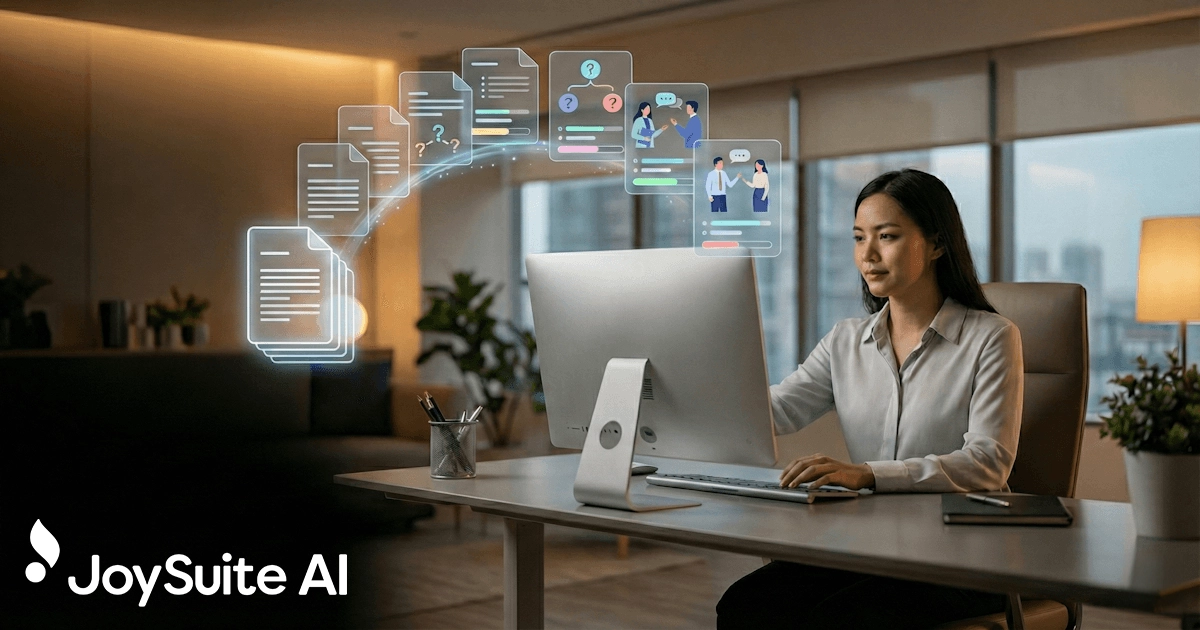
AI Learning Platform: The Next Generation of Corporate Training
The learning management system is evolving. AI-native platforms don't just deliver content; they create it, personalize it, and prove whether employees actually learned. Here's what's changing and how to evaluate this new generation of training technology.

AI LMS for Small Business: Top Options That Won't Break the Budget
Enterprise LMS platforms weren't built for small businesses. The features are overwhelming, the pricing is punishing, and the implementation takes forever. Here's how to find an AI learning solution that actually fits smaller organizations.

AI Onboarding Chatbots: Do They Actually Work?
AI chatbots for onboarding promise instant answers and 24/7 support. But there's a spectrum from genuinely helpful to frustratingly useless. Here's how to tell the difference.

AI-Powered Internal Knowledge Bases: What's Different
AI is fundamentally changing what internal knowledge bases can do. Instead of returning documents for employees to read, AI-powered systems return direct answers with citations.

AI Readiness Assessment: Is Your Organization Prepared?
AI readiness isn't about technical sophistication. It's about content quality, change management capacity, and honest assessment of where your organization actually is, not where you wish it were.

Measuring AI ROI: Beyond Usage Metrics to Business Impact
Tracking AI logins and queries tells you people are using the tool. It doesn't tell you whether they're getting value. Here's how to measure the ROI that actually justifies continued investment.

AI Roleplay for Customer Success Teams
Sales teams use AI roleplay to practice deals. Customer success teams should use it to practice the conversations that keep those customers. Here's how to implement CS-specific roleplay.

AI Roleplay Training: The Complete Guide to Simulation-Based Learning
AI roleplay training enables unlimited practice for high-stakes conversations. Learn how it works, where it applies beyond sales, and how to implement it effectively across your organization.

AI Sales Coaching: How to Scale Training Without Managers
Sales managers don't have time to coach everyone. AI coaching platforms can provide the volume of practice and feedback that scales skill development across the entire team.

AI Security for Enterprise: The Complete Guide
Enterprise AI adoption brings powerful capabilities, and serious security responsibilities. This guide covers everything from data protection to compliance frameworks to building a security-first AI strategy.

AI Solutions for Small Business: Enterprise-Grade Knowledge Without Enterprise Pricing
Small businesses have always competed against organizations with deeper resources, bigger teams, and more institutional knowledge. AI is changing that equation, giving 50-person companies the same knowledge infrastructure that used to require a Fortune 500 budget.

AI Subject Matter Experts: Building Digital Replicas of Your Best People
Your best subject matter experts spend too much time answering repetitive questions. AI SMEs can handle the routine inquiries while your experts focus on work that actually needs their judgment.

AI on a Budget: Enterprise Tools for Not-for-Profits
Nonprofits often feel priced out of the AI revolution, yet they have the most to gain from its efficiency. By focusing on practical applications and selecting tools with accessible pricing, nonprofits can unlock significant capacity.

AI Tools for Instructional Designers: A Practical Guide
AI is changing instructional design, but not in the ways many feared. Rather than replacing designers, AI is automating the tedious production work and freeing professionals to focus on what they do best. Here's how to build an AI toolkit that amplifies your expertise.

AI Training Content Creation: How to Build Courses in Minutes, Not Months
Traditional training development takes months. AI changes the math entirely. This guide shows you how to create effective training content in minutes: from document-to-training conversion to AI-powered assessments.

AI Virtual Experts: How to Clone Your Best People's Knowledge
Every organization has experts everyone relies on. AI virtual experts capture their knowledge and make it available to everyone: without interrupting the people who hold it.

50 AI Workflow Use Cases by Department: A Practical Guide
Stop wondering what AI can do for your team. This guide provides 50 specific workflow use cases organized by department, with enough detail to implement immediately.

5 AI Workflows That Actually Save Time (Not Just Sound Impressive)
Forget 'AI can write poetry.' Here are the workflows where AI is actually making a dent in people's workdays, and how to implement them.

AI Workplace Assistant: The Complete Guide to AI Your Team Will Actually Use
Most enterprise AI tools fail to achieve adoption. This comprehensive guide explains why, introduces the Find-Learn-Do framework for evaluating AI assistants, and shows you how to deploy AI that employees will actually use.

The Art of Delegation: How to Hand Off Work Without It Coming Back
You know you should delegate more. Everyone tells you. You tell yourself. But every time you try, the work comes back. Half-done. Done wrong. Or with so many questions that you might as well have done it yourself.

Certification Programs: How Associations Can Create Ongoing Revenue
As traditional membership dues plateau, associations must find sustainable non-dues revenue. Certification programs offer a powerful solution by creating a recurring revenue loop through exams, preparation materials, and recertification fees.

How Associations Can Turn Expertise into Member Value
Associations possess vast libraries of expert content that often go unused because they are difficult to navigate. AI transforms this static archive into a dynamic, conversational resource that revitalizes the value proposition of membership.

How Associations Can Use AI Without Alienating Members
Members are often wary that AI adoption signals a reduction in service or replacement of human expertise. Associations can avoid backlash by positioning AI as a tool that enhances (not replaces) human connection.

How to Automate Employee Onboarding Without Losing the Human Touch
Smart onboarding automation doesn't replace human interaction. It protects it. By handling routine tasks and information requests, automation frees people for the mentorship and connection that actually matter.

Best AI Course Creator Tools Compared (2025)
The AI course creator market has exploded. Every vendor claims AI features. This guide cuts through the noise to compare what actually matters: speed, quality, ease of use, and total cost of ownership.

10 Best AI Knowledge Management Tools Compared
The AI knowledge management market has exploded. Here's how to make sense of it: comparing features, pricing, and use cases to find the right fit for your organization.

Best AI-Powered LMS Software in 2026: Complete Comparison
Every LMS claims AI capabilities now. But what do they actually deliver? This guide cuts through the marketing to compare what leading platforms offer, where they excel, and which organizations they serve best.

Best AI Onboarding Software: What to Look For in 2025
Every vendor claims to have AI. Few actually deliver the capabilities that make onboarding faster and better. Here's how to evaluate AI onboarding software based on what actually matters.

Best AI Productivity Tools for Teams in 2025: A Practical Comparison
Choosing the right AI productivity tool for your team requires looking beyond feature lists. This guide covers evaluation criteria that actually predict adoption and the tools worth considering in 2025.

Best AI Sales Roleplay Software: A Comprehensive Comparison for 2025
The market for AI sales roleplay software has exploded. We compare the leading platforms (their strengths, limitations, and ideal use cases) to help you choose the right one for your team.

Best HR Knowledge Base Software: 10 Platforms Compared for 2025
The right HR knowledge base can reduce ticket volume by 50% or more. But not all platforms are equal. Here's what to look for and how the top options compare.

15 Best Internal Knowledge Base Software for 2026
Choosing internal knowledge base software? This guide compares 15 leading options across categories: enterprise platforms, SMB solutions, wiki-style tools, and AI-powered systems.

Beyond ChatGPT: What Enterprise AI Actually Requires
ChatGPT proved AI could be useful. But the leap from consumer tool to enterprise platform requires capabilities most organizations don't think to ask about until something goes wrong.

How to Build an AI Knowledge Assistant from Scratch
Building your own AI knowledge assistant is more accessible than ever, but it's not trivial. Here's what's involved, from architecture to deployment.

How to Build a Knowledge Base Employees Will Actually Use
You've probably seen a knowledge base fail before. The content was good. The tool was fine. Something else broke down between 'we built this' and 'people use it.'

How to Build a Learning Culture (Not Just a Training Program)
There's a difference between an organization that has training and an organization that learns. The first kind checks the boxes. The second kind operates differently: learning is woven into how work gets done.

Building a Learning Culture When Everyone's 'Too Busy'
Everyone agrees that continuous learning matters. Everyone also says they don't have time. Both things can be true, if you're approaching learning wrong.

The Business Case for Microlearning
Microlearning isn't just convenient for learners. It delivers measurable benefits across your organization. Here's how it creates value for everyone from frontline employees to executive leadership.

How to Capture Expert Knowledge Before Your Best People Leave
The engineer who's been here since the product was built. The operations manager who knows how things actually work. One day, they're going to leave. What happens to everything they know?

The Case for Self-Service Training Creation
There's a peculiar inefficiency at the heart of how most organizations create training. The people who know the content don't create the training. What if they could?

How to Clone Expert Knowledge with AI (Without the Sci-Fi)
Knowledge cloning sounds futuristic, but it's happening today. Learn how to capture what your experts know and make it accessible to everyone, without those experts having to answer the same questions over and over.

The Coaching Gap: Why Managers Need More Than a Workshop
At some point, most managers attend a workshop on coaching. They learn frameworks: <a href="https://en.wikipedia.org/wiki/GROW_model" target="_blank" rel="noopener">GROW model</a>, active listening, powerful questions. Then they go back to their jobs, and the coaching frameworks gather dust.

Company Wiki vs Knowledge Base: Which Do You Need?
Wikis and knowledge bases both store information, but they serve different purposes. This guide explains when to use each, and introduces an AI-powered alternative that combines the best of both.

Competitive Battlecards: How to Keep Them Updated (Without the Pain)
Battlecards fail when they're treated as static documents rather than living systems. Learn how to create a continuous feedback loop that keeps competitive intelligence trusted and useful.

The Complete Guide to Microlearning
Microlearning is more than short content. It's a philosophy of meeting learners where they are, with focused, searchable, on-demand learning that fits into the modern workflow.

Compliance Training That Doesn't Make Employees Want to Quit
You know the feeling. Annual compliance training is due. You click through scenarios with actors who've never had a real job. Forty-five minutes later, you've learned nothing.

The True Cost of "Let Me Get Back to You"
Every time someone says "let me get back to you," it triggers a chain of interruptions, delays, and inconsistencies that quietly drains thousands of hours and dollars from your organization each year.

How to Create a Benefits FAQ Employees Will Actually Read
You have a benefits FAQ. Somewhere. And yet employees keep asking you the same benefits questions. The document exists. Nobody reads it.

How to Create Training in Minutes Instead of Months
The traditional training development timeline goes something like this: identify a need, get stakeholder buy-in, conduct a needs analysis, develop learning objectives, create a design document... By the time the training goes live, the need has often changed.

Reduce Churn by Closing the Customer Education Gap
Many churned customers never fully adopted your product, not because they didn't want to, but because they didn't know how. A strategic approach to customer education can close this gap and dramatically improve retention.

Customer Health Scores: What They Tell You and What They Miss
Customer health scores are valuable for scanning portfolios at scale, but dangerous if treated as the sole source of truth. Learn what they miss and how to build a true early warning system.

Data Privacy in the Age of AI: What HR Leaders Need to Know
HR data demands a higher tier of protection. As AI adoption accelerates, HR leaders must scrutinize where data travels, whether it is used to train third-party models, and how consent is managed.

The Death of Click-Next Training (And What Comes Next)
We've all done it: clicking through slides, hitting 'next' without reading, passing the quiz through elimination. It's time to admit that traditional e-learning is broken.

Digital Job Aids: From Clutter to Clarity
Job aids are meant to help employees work faster and smarter. But when they pile up in drawers and on bulletin boards, finding the right information becomes its own time-consuming problem.

Eliminate Your Training Backlog with AI
Every L&D team has a backlog. Requests pile up faster than you can fulfill them. AI offers a way out, not by working harder, but by fundamentally changing how training gets created. Here's how to clear your backlog and keep it clear.

Employee Onboarding Checklist: 30-60-90 Day Template
Good onboarding doesn't happen by accident. This 30-60-90 day framework breaks onboarding into three phases, each with different goals.

Employee Self-Service Knowledge Base: Reduce HR Tickets 80%
HR teams answer the same questions hundreds of times per year. An employee self-service knowledge base lets employees find answers instantly, reducing tickets by 60-80% while improving satisfaction.

Enterprise AI Adoption Strategy: The Complete Guide
Most enterprise AI initiatives fail, not because the technology doesn't work, but because organizations skip critical steps in the adoption journey. This guide walks you through the complete process, from assessing readiness to scaling across the enterprise.

Enterprise AI Software Compared: What Actually Works at Scale
Choosing an enterprise AI assistant requires looking beyond demos and feature lists. This guide examines what distinguishes enterprise-grade AI, compares the major platforms, and provides a framework for making the right choice at scale.

Enterprise Knowledge Management: AI Implementation Guide for 2026
Enterprise AI knowledge management isn't just about bigger scale. The requirements around security, governance, and change management are fundamentally different.

Enterprise Search for Regulated Industries: What Compliance Teams Actually Need
Regulated industries face unique enterprise search challenges that generic platforms can't solve. From HIPAA-compliant retrieval to FINRA audit trails, here's what compliance teams actually need from their search infrastructure.

Exit Interviews: How to Capture Knowledge Before Employees Leave
Most exit interviews focus on why someone is leaving. There's another question that rarely gets asked: what do you know that we need to know?

Four Principles for Spaced Repetition That Actually Works
Spacing out learning beats cramming every time. But the specifics of how you space content, and what you ask learners to do with it, significantly impacts results.

Franchisee Onboarding: The First 30 Days That Determine Success
A franchisee's long-term success is often sealed in their first thirty days. Most onboarding programs overwhelm new owners with information rather than building practical competence. Shift from passive training to phased, hands-on support.

The Future of Compliance Training: Interactive, Not Passive
Somewhere right now, an employee is clicking through their annual harassment prevention training. They're also checking email. They'll pass the quiz at the end. Everyone does. Have they learned anything? Almost certainly not.

The Future of L&D: AI-Powered Learning in 2026 and Beyond
AI is transforming learning and development, but not overnight, and not uniformly. Some capabilities are mature today; others remain experimental. Understanding the trajectory helps L&D leaders invest wisely and prepare their teams for what's coming.

The Future of Microlearning: AI, Adaptation, and What's Next
Microlearning has proven itself. Now AI, voice interfaces, and deeper workflow integration are pushing it further. Here's where workplace learning is heading.

How to Get IT to Approve Your AI Tool (Without a 6-Month Review)
IT departments aren't trying to block innovation; they're managing risk. To get your AI tool approved quickly, do the homework for them and frame your request around solving real business problems.

How to Give Feedback Without Triggering Defensiveness
You need to give someone feedback. Real feedback: not praise, not a gentle suggestion, but something they need to hear and probably don't want to. You know what happens next. Their walls go up. They explain, justify, deflect.

Goal Setting for Teams: OKRs, KPIs, and What Actually Matters
Every organization has some goal-setting system. OKRs, KPIs, SMART goals, quarterly objectives. The terminology varies, but the challenge is the same: translating high-level strategy into specific, measurable things that people actually work toward.

From Goldfish Myth to Real Engagement: What Actually Drives Learning
People don't avoid training because their attention spans are too short. They avoid training that's irrelevant, redundant, or boring. Understanding this changes everything.

Grant Compliance Training: What Nonprofits Need to Know
Grant compliance is not just paperwork; it is the safeguard that keeps your funding secure. Effective training must move beyond generic policy recitations to provide role-specific, practical guidance accessible at the moment of decision.

Grounded AI: What It Means and Why Your Business Needs It
General AI tools generate answers from patterns in training data. Grounded AI answers from your specific content. For business applications, this distinction is the difference between useful and dangerous.

How to Handle Benefits Questions During Open Enrollment (Without Losing Your Mind)
It's that time of year again. Your inbox is filling up. The same questions keep coming. People who ignored every communication you sent are suddenly urgent.

How to Handle Difficult Employee Conversations: A Manager's Script
Every manager faces conversations they'd rather avoid. Most don't avoid them because they're cowardly. They avoid them because they don't know what to say.

The Hidden Cost of 'Just Ask Sarah'
Every organization has a Sarah. The person who knows where everything is, how everything works, and what to do when things go wrong. What happens when Sarah leaves?

The Hidden Costs of 'Free' AI Tools in the Enterprise
Free AI tools can seem like an easy way to experiment with AI. But for enterprise use, the hidden costs, security risks, data exposure, and support gaps, often exceed what you'd pay for purpose-built solutions.

The Higher Ed Knowledge Problem: Why Students Can't Find Answers
Universities suffer from a 'knowledge organization problem' where vital information is splintered across departmental silos. This fragmentation forces students to become bureaucratic experts, disproportionately harming first-generation and at-risk students.

From Classrooms to Smartphones
Microlearning didn't emerge from nowhere. It's the result of decades of technology evolution, workplace transformation, and learning science advancement coming together at the right moment.

The History of Microlearning: How We Got Here
Microlearning didn't emerge from nowhere. Understanding its evolution, from CD-ROM training through the smartphone revolution, explains why it resonates so strongly today.

How L&D Teams Are Using AI to 10x Their Output
The most productive L&D teams aren't working harder. They're using AI to transform their workflow. Here are five practical applications that are changing what's possible in corporate learning.

How to Audit Your Company's Knowledge (Template Included)
You can't fix what you can't see. Before you can improve how your organization manages knowledge, you need to understand what you actually have, and what's missing.

How to Create a Knowledge Coach with AI
Transform any LLM into a personalized learning companion. Get a complete prompt template that creates a five-level AI tutor, from 'explain like I'm 5' to expert-level mastery.

How to Choose an AI Learning Platform: Buyer's Checklist
Every vendor claims AI capabilities, but what questions actually reveal whether a platform will work for your organization? Understanding <a href="/blog/how-ld-teams-use-ai/">how L&D teams actually use AI</a> helps frame realistic expectations. This buyer's guide provides a practical framework for evaluating options and making the right choice.

How to Create an Internal Knowledge Base: A Step-by-Step Guide
Creating an internal knowledge base that employees actually use requires more than choosing software. This guide walks through the practical steps from audit to adoption.

How to Design Microlearning That Actually Works
Effective microlearning isn't just short content. It requires intentional design around clear objectives, learner needs, appropriate formats, and measurable outcomes. Here's how to get it right.

How to Stop Overwhelming Your Learners
When training feels exhausting, the problem often isn't the learners or even the content. It's that the experience demands too much mental effort just to navigate.

How to Identify Skill Gaps Before They Become Performance Problems
By the time a skill gap shows up in performance reviews, it's already a problem. Projects have struggled. Deadlines have slipped. The gap has been costing you. You just didn't see it until the damage was done.

The Difference Between Information and Knowledge (And Why It Matters)
We use these words interchangeably, but they're not the same thing. Information is raw material. Knowledge is what happens when it gets into someone's head and becomes useful.

Building Internal AI Knowledge Assistants for Teams
Every internal team has knowledge that others need. AI knowledge assistants can make that knowledge accessible without turning your experts into help desks.

Internal Knowledge Base Examples & Templates
Looking for internal knowledge base examples? This guide provides concrete templates and structures for different use cases, from HR policy centers to IT help desks to sales enablement hubs.

Internal Knowledge Base: The Complete Guide to Building Your Company's Single Source of Truth
An internal knowledge base can transform how your organization shares information, if you build it right. This comprehensive guide covers everything from choosing features to measuring success.

Just-in-Time Learning: Getting Employees Answers When They Need Them
There's a moment every employee knows. You're in the middle of something (a customer call, a complex task, a decision that needs to be made) and you realize you don't know something you need to know. What happens next determines a lot.

How to Keep a Remote Team Aligned Without Micromanaging
Your team is distributed. Some work from home, some from different cities, some from different time zones. The casual alignment that happened naturally in an office (overhearing conversations, quick desk drop-bys, spontaneous whiteboard sessions) doesn't happen anymore.

AI and Knowledge Management: What's Changed and What Works in 2026
Knowledge management has been around for decades, yet employees still can't find what they need. AI is changing this, but not in the way most people think.

Knowledge Management for Distributed Teams
Distributed teams face unique knowledge challenges. Information gets siloed by timezone. Expertise disappears when someone leaves. New hires struggle to find answers. Here's how to build knowledge systems that actually work across locations.

Knowledge Management for Higher Education: Faculty, Staff, and Students
Universities are vast repositories of knowledge, yet their operational information is often fragmented across decentralized departments. AI addresses this by acting as a unifying layer, allowing users to ask questions and receive accurate answers.

Knowledge Preservation with AI: How to Stop Expertise from Walking Out the Door
When experienced employees leave, their knowledge often leaves with them. AI-powered knowledge preservation can capture institutional expertise and make it accessible long after the experts have moved on.

Knowledge Silos Are Costing You More Than You Think
Every organization has knowledge silos. Most executives are vaguely aware it's a problem. But the full cost is hidden, distributed and invisible across every decision.

The Knowledge-to-Action Gap: Why Information Alone Isn't Enough
Providing more information does not automatically lead to better performance. The knowledge-to-action gap persists because of friction in accessing knowledge at the moment of need, lack of practical skills application, and environmental barriers.

The L&D Bottleneck: Why Every Department Is Waiting for Training
Sales needs training on the new product. Customer success needs training on the updated process. HR needs training on the new benefits platform. Everyone needs training. And everyone is waiting for L&D.

LMS with AI Features vs AI-Native Learning Platforms: A Critical Distinction
Every LMS now claims AI capabilities. But there's a fundamental difference between platforms that added AI features and those built around AI from the start. The distinction affects what's possible, how fast the platform evolves, and whether AI delivers real value or just marketing appeal.

The Complete Guide to Manager Effectiveness
Most managers are promoted because they were good at their previous job. Then they discover that management requires entirely different skills, skills nobody taught them. This guide covers everything effective managers need: the mindset shift, core skills, common traps, and how to leverage AI to spend more time leading and less time administering.

The Manager's AI Toolkit: 10 Workflows That Save Hours Every Week
Managers are drowning in work that isn't managing. Writing. Summarizing. Searching. Administrative tasks that consume hours but don't develop people, don't advance strategy, and don't move the important work forward.

The Manager's Guide to Answering HR Questions (When HR Isn't Available)
It's 4:45 pm on Friday. One of your team members asks about adoption leave. HR left an hour ago. What do you actually say?

The Manager's Guide to Creating Training (Without Being an Instructional Designer)
Your team needs training on something. You could submit a request to L&D and wait weeks or months. Or you could create it yourself. That second option feels daunting, but it doesn't have to be.

How to Measure Training Effectiveness (Beyond Completion Rates)
"95% of employees completed the training." This number shows up in most training reports. It looks good in a dashboard. It also tells you almost nothing about whether the training worked.

Meeting Summaries: How to Never Lose Action Items Again
How many meetings have you left feeling productive, only to realize a week later that nothing actually happened? The action items vanished. The decisions weren't documented. The follow-ups never followed up.

Microlearning Formats
Microlearning isn't just short videos. From text-based chatbots to interactive scenarios to audio podcasts, the format should match the content, context, and how learners will actually use it.

Microlearning in Action
Microlearning shines in specific contexts: onboarding support, compliance mastery, performance reinforcement, knowledge retention, and more. Here's where it delivers the greatest impact.

Microlearning vs. Traditional Training: When to Use Each
Microlearning has become something of a buzzword. Short bursts of content. Bite-sized learning. But microlearning isn't a universal replacement for traditional training. It's a different tool, suited to different purposes.

How Microlearning Fits the Modern Workflow
The best learning doesn't pull people away from work. It's woven into work itself. Microlearning makes this possible by delivering answers at the moment of need.

Multi-Location Training: Same Content, Every Location, Every Time
Your best and worst locations likely received the exact same training materials, yet their performance differs. The gap isn't content distribution. It's knowledge retention. AI provides instant answers and continuous reinforcement across locations.

The New Employee's First 48 Hours: What Makes or Breaks Onboarding
A new employee walks in on their first day. They're nervous, excited, and paying very close attention. The next 48 hours will shape how they feel about this job for months.

The New Manager Survival Guide: Your First 90 Days
Congratulations, you're a manager now. You got promoted because you were good at your job. The problem is: your job just changed completely. The skills that got you here aren't the skills you need now.

The Objection Handling Playbook: Practice That Scales
True objection handling fluency requires volume and variety, not just occasional training sessions. Learn how AI enables unlimited, low-stakes practice that transforms hesitation into confident responses.

The Performance Review Overhaul: Making Feedback Actually Useful
Performance reviews are universally dreaded. Managers hate writing them. Employees hate receiving them. And after all that pain, the feedback often doesn't change anything.

From Pilot to Production: Scaling AI Across the Enterprise
Pilots prove technology works. Scaling proves the organization can adopt it. The skills, strategies, and mindset for each are different, and most organizations only prepare for the first.

The Policy FAQ Problem: Why Employees Can't Find Answers
You have an employee handbook, an FAQ page, and policies documented somewhere. The information exists. And yet, every day, employees ask questions that are answered in those documents.

How to Practice Objection Handling with AI
The best objection handlers don't think about what to say. They've practiced until the right response is automatic. Here's how to use AI practice to build that fluency.

How to Prepare for Difficult Conversations (Without Losing Sleep)
The conversation is tomorrow. You've been dreading it for days. You lie awake rehearsing what you'll say, imagining how they'll respond, running through worst-case scenarios. By the time the meeting arrives, you're exhausted and no more prepared than when you started.

Prompt Engineering Is a Bandaid (Here's What's Next)
Companies are spending millions training employees to write better prompts. There's a simpler approach that actually scales.

QBR Prep: How to Build Customer Presentations in Minutes
QBRs often fail because CSMs spend too much time building slides and not enough time crafting the strategic narrative. Learn how to separate data gathering from deck creation for faster, better presentations.

What is RAG? How AI Assistants Retrieve Knowledge
RAG is the architecture that makes AI knowledge assistants possible. Here's how it works, in terms anyone can understand.

The Real Cost of Per-Seat AI Pricing: A CFO's Guide
While per-seat pricing offers predictability for traditional software, it often masks significant waste in enterprise AI adoption due to variable usage rates and shelfware.

How to Reduce HR Ticket Volume by 50%
Your HR team is drowning in tickets. Every ticket takes time. Here's how to cut routine volume by half and free your team for strategic work.

Reduce New Hire Ramp Time by 50% with AI
Traditional onboarding takes too long because new hires spend too much time waiting, searching, and sitting through generic training. AI attacks each of these time sinks directly.

Remote Onboarding: How to Make New Hires Feel Like Part of the Team
Remote onboarding has none of the visceral first-day experience. It can work, but it doesn't happen automatically. Everything has to be deliberately created.

Roleplay Training: How AI Makes Practice Scalable
Everyone agrees that practice is essential for skill development. You can't learn to handle difficult conversations by reading about them. And yet, most corporate training is passive. AI is changing what's possible.

How to Run Better 1:1s (With Less Prep Time)
One-on-ones are supposed to be sacred. The time you invest in your people. In practice, they often become something else: quick check-ins that could have been a Slack message.

How to Prepare for Sales Calls in 5 Minutes Instead of 30
The problem isn't usually a lack of time. It's a lack of system. Learn a repeatable 5-minute routine that gives you deep context for every sales call.

Onboarding New Sales Reps: The 30-Day Ramp Plan
Effective sales onboarding isn't a two-week classroom event. It's a structured transition from learning to doing. This 30-day plan prevents the 'sink or swim' failure mode.

Sales Simulation vs Live Training: What Works Better
AI simulation and live training each have distinct strengths. The question isn't which is better. It's how to combine them effectively for optimal skill development.

The Sales Training Playbook: Onboarding Reps in Half the Time
Most organizations take three to six months to get a new sales rep to full productivity. This timeline isn't inevitable. Rethink the approach, and you can cut it significantly.

Enterprise AI Search: From Scattered Documents to Searchable Knowledge
Files in SharePoint, Google Drive, the old shared drive, wikis, Notion pages, Confluence spaces, PDFs in email attachments. The knowledge exists, scattered across a dozen systems. Here's how to fix it.

The Science of Microlearning
Microlearning isn't just convenient. It's backed by decades of cognitive science research. Understanding the brain science explains why short, focused learning beats marathon training sessions.

Self-Service HR: What Employees Actually Want to Look Up Themselves
There's a persistent myth that employees want to talk to a human for everything. The truth: they'd rather find routine answers themselves, if they can.

Self-Service Onboarding: Give New Hires Answers Without Bottlenecks
Every question a new hire has to wait on is lost productivity. Self-service onboarding gives them instant access to accurate answers, accelerating ramp time while freeing up colleagues.

Shadow AI: The Risk You're Already Taking
While organizations debate official AI adoption, employees have already decided. They're using ChatGPT, Claude, and other tools on personal accounts, with company data, outside any governance framework.

5 Signs Your AI Adoption Has Plateaued (And How to Fix It)
Most AI initiatives see strong initial adoption, then hit a wall. Learn to recognize the signs of a plateau early and apply proven strategies to move past it.

Single Source of Truth: What It Really Means
"Single source of truth" gets thrown around without much examination. The underlying concept actually matters. Here's what it really means and why it's harder than it sounds.

Time Management for Managers: Stop Being the Bottleneck
Your calendar is full. Your inbox is overflowing. Your team is waiting on you: for approvals, for answers, for decisions. You're working harder than ever and still falling behind. The problem isn't that you need better time management. The problem is that you've become the bottleneck.

Traditional LMS vs AI Learning Platform: What's Actually Different
Every LMS vendor now claims AI capabilities. But there's a fundamental difference between a traditional platform with AI features added and one built around AI from the start. Here's what actually changes, and why it matters for your organization.

Training for Distributed Teams: What Works in an AI-Enabled World
Training used to assume proximity. Everyone in the same room, learning together. The instructor could read the room. Afterward, people could tap a colleague on the shoulder. Distributed teams have none of this.

Training Verification: Moving Beyond "Click Next to Continue"
Click. Click. Click. Scroll to the bottom. Answer the quiz questions that are obviously correct. Certificate downloaded. Training complete. Did you learn anything? Probably not. But you're marked as trained.

The True Cost of a Mis-Hire (And How Better Training Can Help)
Everyone knows mis-hires are expensive. The actual cost is usually worse than the common estimates, and a significant portion aren't really hiring failures at all.

How to Turn Any Document into a Quiz (Step-by-Step)
You have a document. A policy, a process guide, a product spec. You need people to actually learn what's in it, not just read it and forget it. Here's how to turn any document into a quiz, step by step.

How to Upskill Your Workforce Without Blowing Your Budget
The pressure to upskill has never been higher. Technologies shift. Roles evolve. And yet budgets aren't infinite. The solution isn't to give up on upskilling. It's to get smarter about how you do it.

Usage-Based vs. Per-Seat AI Pricing: Which Model Works for Enterprise?
Pricing isn't just about cost. It's about incentives. The wrong AI pricing model can quietly undermine your adoption goals even when the technology works perfectly.

The Weekly Standup, Reinvented: Making Updates Async Without Losing Alignment
The daily standup: fifteen minutes where everyone shares what they did yesterday, what they're doing today, and what's blocking them. In theory, it's a quick alignment ritual. In practice, it's often fifteen minutes of people waiting for their turn to talk.

What Actually Makes Learning Effective
Effective learning isn't about fancy technology or clever design tricks. It's about respecting how human memory actually works, and building experiences around those realities.

What Your HR Ticket Queue Is Telling You
Your HR ticket queue is a goldmine of information that almost nobody mines. Every ticket is a signal about where the employee experience is broken.

What Is Microlearning?
Microlearning is more than short videos. It's a philosophy of meeting learners where they are, with focused, searchable, on-demand content that fits into the natural flow of work.

Bug or Feature? When to Leverage AI Hallucinations for Creative Tasks
AI hallucinations cause anxiety for business leaders. But what if that same capability could be harnessed for creative work while ensuring accuracy when it matters?

Why Most Enterprise AI Pilots Fail (And How to Avoid It)
While technical implementation is often successful, most enterprise AI pilots fail to scale due to organizational oversights. Here's how to avoid the common pitfalls.

Why Banning Smartphones at Work Is a Mistake
Smartphone bans are becoming more common in workplaces, but they ignore a fundamental truth: your employees' phones might be their most powerful productivity tool.

Why Most Harassment Prevention Training Fails
Studies reveal a troubling pattern: much harassment prevention training not only fails to prevent harassment. It can actually make workplace dynamics worse.

Why "Short" Training Isn't Enough
Breaking training into smaller chunks is a good start. But truly effective learning requires more than just brevity. It requires personalization.

Why Your Team Isn't Using That AI Tool You Bought
That AI tool seemed promising when you bought it. Now it's gathering digital dust while employees work the old way. Here's why, and what actually drives adoption.

Why "We Don't Train on Your Data" Should Be Table Stakes
Allowing AI vendors to train models on your proprietary data creates significant risks regarding confidentiality, compliance, and competitive leakage. "No training on customer data" is not a premium feature. It is the baseline requirement.

Why Your Team Forgets 90% of Their Training (And What Actually Works)
Research shows people forget up to 90% of new information within a week. For the knowledge your team truly needs to internalize, spaced repetition is the proven solution.

Why Your Wiki Isn't Working (And What to Do Instead)
Your wiki has thousands of pages that nobody uses. The tools weren't bad. The intentions were good. Something about the approach just didn't work.

Work and Learning Are Merging: What That Means for Your Organization
The traditional boundary between 'working' and 'learning' is dissolving as the half-life of skills shrinks and AI makes knowledge accessible in the moment of need. Organizations must shift from event-based training to infrastructure for continuous development.

How to Write Job Descriptions That Attract the Right Candidates
Most job descriptions are written to check a box, not to attract great candidates. They're assembled from templates, with aspirational requirements and generic language.

How to Write Performance Reviews That Actually Help Employees Grow
Performance review season arrives and managers scramble. They stare at blank forms trying to remember six months of work. They write vague praise that sounds good but means nothing. They avoid hard truths because it's uncomfortable.
Ready to transform how your team works?
Join organizations using JoySuite to find answers faster, learn continuously, and get more done.